A group joining Mt Kailash tour puts you on a fixed departure date alongside other travelers, sharing the cost of permits, transport, and guide, which makes it the more affordable option, typically starting from around USD 1,400 to 2,000 per person depending on season and departure. A private Mt Kailash tour is arranged exclusively for you or your own group, with flexible dates and a pace you control, but at a higher per-person cost since those same fixed costs aren’t shared across a larger group. Most first-time pilgrims and budget-conscious travelers choose group joining; those prioritizing flexibility, privacy, or a specific departure window tend to choose private.
What Is a Group Joining Mt Kailash Tour?
A group joining tour is a fixed-departure trip: the operator sets specific dates in advance, and individual travelers or small parties book onto that shared departure. You’ll travel with a group of pilgrims and trekkers you likely haven’t met before, all following the same itinerary, guide, and vehicle.
Because the fixed costs of a Kailash trip, including permits, guide fees, vehicle rental, and yak or porter support, are split across everyone in the group, this is consistently the more budget-friendly way to reach Kailash.
What Is a Private Mt Kailash Tour?
A private tour is arranged exclusively for you, your family, or your own travel party. You choose (within seasonal constraints) your own departure date, set your own pace, and the itinerary can be adjusted to your preferences: extra rest days, a different route combination, or add-ons like Lhasa or Everest Base Camp built around your schedule rather than a fixed group calendar.
The trade-off is straightforward: since you’re not sharing costs with other travelers, the per-person price is meaningfully higher.
Side-by-Side Comparison
Group Joining Tour
Private Tour
Departure dates
Fixed, pre-scheduled dates
Flexible: choose your own dates within the season
Price per person
Lower, since costs are shared across the group
Higher, since costs are borne by your party alone
Group size
Typically joins other travelers (often 4+ pax)
Just you and/or your own party
Pace
Set by the group itinerary
Can be adjusted to your preferences
Itinerary flexibility
Fixed, standard route
Customizable: extra days, different add-ons
Best for
Solo travelers, budget-conscious pilgrims, first-timers
Families, groups of friends, travelers with specific dates or needs
Booking lead time
Needs to align with existing departure dates
More flexible, though permits still need 30+ days
Pros and Cons of Group Joining Tours
Pros:
Significantly more affordable per person
A built-in social element, since many pilgrims value sharing the experience with others on the same spiritual journey
Simpler decision-making, since the itinerary and logistics are already set
Easier for solo travelers, since you’re automatically placed with a group rather than needing to find travel companions
Cons:
You’re locked into the operator’s fixed departure dates
Pace is set by the group, so extra rest days or a slower schedule are harder to arrange
Less control over exactly who you’re traveling with
Itinerary customization (adding Lhasa, Everest Base Camp, or extra days at Manasarovar) is limited or unavailable
Pros and Cons of Private Tours
Pros:
Full control over departure dates within the travel season
Itinerary can be tailored, with extra acclimatization days, different combinations with Lhasa or Everest, or a slower or faster pace
Travel exclusively with people you know
More flexibility if health, age, or fitness considerations call for a more cautious pace
Cons:
Meaningfully higher cost per person, since fixed costs aren’t shared across a larger group
Requires more advance planning and communication to build a custom itinerary
Smaller parties may find some costs (vehicle, guide) less efficient than a full group
How Does Pricing Actually Compare?
Group joining Kailash tours from Kathmandu typically range from around USD 1,400 to 2,000+ per person, varying by season, departure date, and accommodation standard. This usually covers Tibet Travel Permit and Alien’s Travel Permit processing, guide, transport, twin-sharing accommodation on a bed-and-breakfast basis, and emergency oxygen support, with lunch, dinner, insurance, and visa fees charged separately.
Private tours are priced per group rather than per person against a fixed rate, since the same core costs (permits, guide, vehicle, yak support) are spread across fewer travelers. As a rough guide, expect private tour pricing to run noticeably higher per person than the group joining rate, with the exact figure depending heavily on your group size: a private tour for a family of 4 works out quite differently than a private tour for a couple.
Because private pricing is genuinely itinerary-dependent, it isn’t something that fits neatly into a fixed number. The most accurate way to get a real figure is to share your group size and preferred dates directly.
Which One Should You Choose?
Choose a Group Joining Tour if:
Budget is a primary consideration
You’re traveling solo or as a couple and don’t mind joining other pilgrims
The operator’s existing departure dates work with your schedule
You’re comfortable with a standard, well-tested itinerary
Choose a Private Tour if:
You’re traveling with family or a group of friends and want to stay together exclusively
You need specific dates that don’t align with fixed group departures
You want a customized itinerary, extra rest days, a different combination with Lhasa or Everest, or a gentler pace for older travelers
Cost is a lower priority than flexibility and control
Frequently Asked Questions
Is a group joining tour safe for solo travelers, especially women? Yes. Group joining tours are a common and popular way for solo travelers to do the Kailash Kora, since you’re automatically part of a supervised group with an experienced guide throughout.
Can I upgrade from group joining to private after booking? This depends on timing and availability, since permits and itinerary planning differ between the two formats. If you’re unsure, it’s worth discussing your priorities with your operator before booking either option.
Does a private tour mean better accommodation? Not necessarily. Accommodation standard (budget vs. upgraded) is usually a separate choice from group vs. private format. A private tour gives you control over dates and pace; accommodation upgrades are typically an additional option on either format.
How much more expensive is a private tour compared to group joining? It varies significantly based on your group size, since fixed costs are spread across fewer people. A private tour for a larger family group can end up reasonably close to group joining rates per person, while a private tour for just one or two people will cost considerably more per head.
Can I customize a group joining tour itinerary? Generally no. The appeal of a group joining tour is the fixed, already-optimized itinerary. If customization matters to you, a private tour is the better fit.
Which option is more common for first-time Kailash pilgrims? Group joining tours are generally more popular among first-time visitors, largely due to cost and the reassurance of a well-established, repeatedly-run itinerary.
Ready to Choose Your Kailash Tour Format?
If budget-friendly and straightforward is what you’re after, take a look at our Mt Kailash Group Joining Tour 2027 for current departure dates and pricing. If you’d prefer a private, customized journey, with your own dates, pace, and itinerary additions, send us an inquiry with your group size, preferred travel window, and any specific requirements, and we’ll put together a private quote tailored to your trip.
A trip to Mount Kailash requires more paperwork than a standard Tibet trip because the region — Ngari Prefecture — is a restricted, military-sensitive border area. Foreign travelers typically need a Chinese Visa (or China Group Visa via Nepal), a Tibet Travel Permit, an Alien’s Travel Permit, and a Military Area Entry Permit, with a Foreign Affairs Permit also required on some routes. None of these can be arranged independently — all are processed by a licensed Tibet travel agency. Restricted-area permits for Kailash typically take 20–30 days to process, longer than a standard Lhasa-only trip, so booking at least 2–3 months ahead is recommended.
Why Does Mount Kailash Need Extra Permits?
Mount Kailash sits in Ngari Prefecture, in the far western corner of the Tibet Autonomous Region, close to where the borders of China, Nepal, and India meet. Because of that location, Ngari is classified as a military-sensitive zone, which means it requires permits on top of the standard Tibet Travel Permit that covers a normal Lhasa trip.
This is the single biggest reason a Kailash trip needs more lead time than, say, a Lhasa-and-Everest itinerary — the additional permits take longer to process and involve more government departments.
The Full List of Permits for Mount Kailash
Permit
Issued By
Purpose
Chinese Visa (or China Group Visa)
Chinese Embassy/Consulate, or via Kathmandu for the Nepal route
Entry into China
Tibet Travel Permit (TTP)
Tibet Tourism Bureau
Entry into the Tibet Autonomous Region
Alien’s Travel Permit (ATP)
Public Security Bureau
Travel beyond Lhasa into western Tibet, including Ngari
Military Area Entry Permit
Military authorities, Lhasa
Access to Ngari Prefecture specifically
Foreign Affairs Permit
Foreign Affairs Office, Lhasa
Required on some routes into Ngari, alongside the Military Permit
Most foreign travelers visiting Kailash end up needing all of the above, though the exact combination can depend slightly on which route you’re taking into the region — more on that below.
Does the Route You Take Change What You Need?
Yes, and this is a detail a lot of generic guides skip over.
Via Kathmandu (Nepal overland route): This is the route most travelers on a group joining tour take. You’ll need a China Group Visa (arranged in Kathmandu), plus the Tibet Travel Permit, Alien’s Travel Permit, and Military Area Entry Permit.
Via Lhasa (starting from mainland China): Because this route passes through several additional prefectures on the way to Ngari, it more commonly also requires the Foreign Affairs Permit alongside the Military Permit.
Since permit combinations are genuinely route-dependent, the most reliable approach is to lock in your exact itinerary first and let your travel agency confirm precisely which permits apply — rather than assuming your friend’s permit list from a different route matches yours.
Permit Timeline: How Long Does It Take?
For a Kailash trip, plan for the process to take noticeably longer than a standard Tibet permit:
Standard Tibet Travel Permit alone: around 15–20 working days
Kailash/Ngari permits (TTP + Alien’s Travel Permit + Military Permit, and Foreign Affairs Permit where applicable): typically 20–30 working days
A reasonable planning timeline looks like this:
2–3 months before departure: Confirm your itinerary and book with a licensed Tibet agency — this is when the permit clock starts.
60–30 days before departure: Submit your passport scan and required documents to your agency.
20–30 days before departure: Restricted-area permits for Ngari are processed.
Around 15–20 days before departure: Your agency should have all approved permits in hand and confirm everything with you.
Because Ngari permits involve more government departments than a standard Lhasa trip, it’s worth building in a buffer rather than cutting it close — permit delays are far easier to absorb with extra lead time than with none.
What Documents Will You Need to Provide?
A scanned copy of your passport’s photo page, valid for at least six months beyond your travel dates
A recent passport-style photo
A copy of your Chinese visa, or confirmation of your visa-free eligibility if applicable
Your confirmed Kailash tour itinerary and dates
For Indian nationals specifically: additional documentation processed through recognized channels working with the Tibet Autonomous Region’s Foreign Affairs Office, since the process for Indian pilgrims differs somewhat from other nationalities
A Note for Indian Pilgrims
Mount Kailash and Lake Manasarovar draw a significant number of Indian pilgrims each year, and the permit process for Indian nationals runs through a slightly different channel than for other foreign travelers — typically coordinated between Nepali or Indian travel agencies with established ties to the relevant Tibetan authorities. If you’re an Indian passport holder, it’s worth confirming with your agency early that they have direct experience processing Kailash permits for Indian pilgrims specifically, since this isn’t identical to the general foreign-traveler process.
Common Permit Mistakes to Avoid
Booking flights before permits are confirmed. Since permits are itinerary-specific and take weeks to process, buying non-refundable flights too early creates unnecessary risk if anything needs adjusting.
Assuming visa-free entry to China removes the need for Tibet permits. It doesn’t — Tibet Travel Permits and Ngari-specific permits are required regardless of your visa status.
Changing your itinerary after permits are submitted. Because permits are matched to a specific route, last-minute itinerary changes can mean re-processing, which costs time you may not have.
Assuming all Kailash routes need identical permits. As covered above, the Kathmandu route and the Lhasa route don’t always require exactly the same combination.
Frequently Asked Questions
How many permits do I need for Mount Kailash? Most foreign travelers need four documents on top of their passport: a Chinese Visa (or Group Visa), a Tibet Travel Permit, an Alien’s Travel Permit, and a Military Area Entry Permit, with a Foreign Affairs Permit required on some routes.
Can I apply for Kailash permits myself? No. All permits for Tibet, and especially for restricted areas like Ngari, must be processed through a licensed Tibet travel agency. Independent travel to Kailash isn’t permitted for foreign visitors.
How far in advance should I start the permit process for Kailash? At least 2–3 months before departure is recommended, given that restricted-area permits for Ngari can take 20–30 working days to process, on top of time needed to confirm your itinerary and gather documents.
Do visa-free travelers still need Kailash-specific permits? Yes. Visa-free entry to China only addresses your entry into the country — it doesn’t remove the requirement for a Tibet Travel Permit or the additional Ngari-specific permits.
Is the permit process different if I’m traveling via Kathmandu instead of Lhasa? Yes, to some degree. The Kathmandu route typically involves a China Group Visa and generally doesn’t always require the Foreign Affairs Permit that some Lhasa-route itineraries need, though the Tibet Travel Permit, Alien’s Travel Permit, and Military Permit apply either way.
What happens if my itinerary changes after permits are submitted? Since permits are matched to your specific route and dates, significant itinerary changes can require re-submission, which adds processing time. It’s best to finalize your route before permits are filed.
Is the permit process different for Indian pilgrims? Yes. Indian nationals typically go through a separate coordination channel involving recognized agencies with established ties to the relevant Tibetan authorities, distinct from the general international traveler process.
Ready to Start Your Kailash Permit Process?
Because Kailash permits are route-specific and take longer than standard Tibet permits, the earlier you lock in your itinerary, the smoother the process. Our Mt Kailash Group Joining Tour 2027 includes permit processing as part of the package. Send us an inquiry with your nationality, passport type, and preferred travel dates, and we’ll map out exactly which permits your trip needs and the timeline to get them.
On the morning of August 26, 2026, a catastrophic glacial-triggered flash flood swept down the Bhote Koshi/Trishuli river corridor along the Nepal–Tibet border, devastating Rasuwa, Nuwakot, Dhading, Gorkha, and several other districts. Entire villages, roads, bridges, and hydropower projects were washed away in a matter of minutes. This is one of the worst natural disasters our region has faced in recent memory, and its scale is still becoming clear.
We are sharing this update because our own travelers and staff were among those caught in this disaster, and because we know there are many other families — of tourists, of trekking staff, of local residents — who are searching for the same answers we are.
Our Group
Our tour was organized as an authorized Tibet travel agency since 2000 consisting of 72 people in total — 58 travelers and 14 of our own guides and support staff — who were completing the final day of their journey, returning from Tibet and crossing back into Nepal.
Our last confirmed contact with the group was at approximately 8:30 AM on August 26, when they were at the immigration checkpoint attempting to cross the border into Nepal. We have not been able to reach them since.
We want to be completely honest with you: we do not have further confirmed information beyond this point. We are in continuous contact with Nepali authorities, our local partner, and emergency responders, and we will share any verified update — positive or otherwise — the moment we receive it. We will not speculate, and we ask for patience as search and rescue teams work through extraordinarily difficult conditions.
The Scale of This Disaster
This flood did not affect only travelers. According to Nepal’s National Disaster Risk Reduction and Management Authority (NDRRMA) and international reporting, the disaster has caused massive loss of life across multiple districts, with many hundreds of people — locals and foreign nationals alike — still unaccounted for. Dozens of bridges, tens of kilometers of road, hydropower infrastructure, and entire settlements along the river have been destroyed, severely hampering rescue efforts. Search, rescue, and recovery operations by the Government of Nepal, the Nepal Army, Nepal Police, and international responders are ongoing.
We want to say clearly: our thoughts are not only with our own travelers and team, but with every family — Nepali and foreign — who is waiting for news of someone they love, and with the local communities who have lost homes, livelihoods, and family members in this disaster.
Guidance for Families With a Missing Loved One (Including Those Not Traveling With Us)
If you have a family member who was in the affected region and you have not yet had contact with them, whether or not they were part of any organized tour, we strongly encourage you to reach out to the following official channels directly:
Nepal Police – for reporting missing persons and coordinating DNA identification
Department of Hydrology and Meteorology – toll-free 1155 for flood and weather updates
Your country’s embassy or consulate in Kathmandu, which can coordinate with Nepali authorities on your behalf
Nepal Red Cross Society, which is assisting with tracing and family reunification
If your relative was traveling with a different tour operator, please also contact that company directly, as they may have last-known location or contact details that can help authorities narrow the search.
DNA Sampling for Identification of Recovered Bodies
Because of the scale of this disaster and the condition in which many bodies have been recovered, the Government of Nepal has asked families of missing persons — including those living outside Nepal — to submit DNA samples to support identification. This is a standard and necessary forensic process, and we understand how painful it is to even read about it. We share it only because Nepal’s disaster authorities have specifically requested this information reach families abroad who may not otherwise know the process exists.
According to the official notice issued by Nepal’s National Disaster Risk Reduction and Management Authority (NDRRMA), the process is as follows:
DNA samples should be provided by the closest available blood relative of the missing person, in this order of preference: mother, father, son, or daughter, followed by a biological brother or sister sharing both parents. If none of these are available, another blood relative from the same family may provide a sample.
Spouses, adopted family members, step-relatives, and in-laws cannot be used, as they do not share DNA with the missing person.
Families must also submit a copy of the donor’s photo ID (passport or national ID) and a signed consent letter authorizing use of the DNA sample solely for identification purposes, and specifying the donor’s relationship to the missing person.
Scanned documents and DNA reports should be sent to the Nepal Police. Samples are processed at the Nepal Police Forensic Science Laboratory, with additional support from the Nepal Academy of Science and Technology and international forensic teams.
Authorities have confirmed this information is kept strictly confidential and used only for identification.
We want to gently note, as Nepali authorities and foreign embassies have also stated: being asked to provide a DNA sample does not mean a body has been identified as your loved one, and it does not mean any conclusion has been reached about their status. It is a precautionary step being requested of all families with a missing relative, given how many bodies have needed to be recovered and, due to urgent public health requirements, buried before identification could be completed.
If you are a family member seeking to begin this process, please contact the Nepal Police or your embassy in Kathmandu for the current submission procedure, as details may be updated as the response continues.
Supporting the Recovery
This disaster has affected far more than any one group of travelers. Entire communities have lost homes, roads, bridges, and the infrastructure they depend on for daily life. The Government of Nepal, through the Office of the Prime Minister and Council of Ministers, has appealed for public support toward rebuilding through two official channels:
Prime Minister’s Disaster Relief Fund (प्रधानमन्त्री दैवी प्रकोप उद्धार कोष)
Prime Minister’s Relief Fund (प्रधानमन्त्री राहत कोष)
By law, these funds may only be used for rescue, treatment, relief, rehabilitation, and infrastructure restoration. We encourage anyone who is able to contribute, whether a small amount or a large one, to do so through this official channel, and to be cautious of unofficial or unverified fundraising pages.
A Word on Why This Happened
Early assessments from Nepali and international authorities point to a glacial collapse near Langtang Lirung, which triggered this catastrophic chain of debris flows and flash flooding. Events like this are becoming more frequent across the Himalayas as glaciers retreat and high-altitude ice and rock formations destabilize in a warming climate. This is not an isolated tragedy — it is part of a pattern that scientists have been warning about for years.
We say this not to politicize a moment of grief, but because we believe it matters: if we do not take the protection of these fragile mountain environments seriously, more communities, more travelers, and more families will face what so many are facing right now. Conserving the natural systems we all depend on is not an abstract cause. It is, quite literally, about protecting human lives.
To Every Family Still Waiting
To the families of our own 58 travelers and 14 team members, and to every family, Nepali or foreign, still waiting for word of someone they love: we see you, and we will not stop seeking information until we have real answers for you. To the families of the local residents, guides, drivers, and hydropower workers who lived and worked in these valleys and who are among the dead and missing, our grief extends to you as well. This land is not just a route through the mountains to us. It is home to people we have worked alongside for years.
We will continue to update this page as we receive verified information. If you are a family member of someone in our group and need to reach us directly, please contact us at info@tibettour.travel
Official Sources and Resources Referenced
Nepal National Disaster Risk Reduction and Management Authority (NDRRMA) — DNA sample notice https://ndrrma.gov.np/en/rasuwa
The Mount Kailash Kora is physically demanding but not technically difficult — there’s no climbing or mountaineering involved, just walking on dirt, gravel, and rocky trails at high altitude. Most days involve 5–8 hours of walking, with Day 2’s crossing of Dolma La Pass (5,630m) being the hardest section. You don’t need to be an athlete, but a reasonable baseline of cardiovascular fitness and 8–12 weeks of preparation beforehand make a significant difference. People in their 60s and 70s complete the kora regularly; the key factors are training, pacing, and proper acclimatization, not age or elite fitness.
Is the Kailash Kora Difficult?
Yes, but it’s worth being precise about what kind of difficult. The Kailash Kora is physically demanding, not technically challenging. You won’t need ropes, crampons, or climbing experience — the entire route follows established trails, mostly dirt, gravel, and rocky ground.
What makes it hard is the combination of three things happening at once:
High altitude — most of the route sits above 4,500m, with the pass crossing over 5,600m
Distance and duration — roughly 52 km spread across 3 days, with long walking hours each day
Terrain and conditions — uneven, rocky trails, potential ice or loose stone even in summer, and unpredictable mountain weather
None of these individually would be extreme, but together they add up to a trek that genuinely tests your stamina, even for people who consider themselves generally fit.
Day-by-Day Difficulty Breakdown
Day
Route
Difficulty
Why
Day 1
Darchen → Dirapuk
Moderate
Manageable distance, but altitude effects begin
Day 2
Dirapuk → Zutulpuk (via Dolma La Pass)
Hardest day
Steep climb to 5,630m, long descent, cold and wind exposure
Day 3
Zutulpuk → Darchen
Easier
Shorter, mostly downhill, fatigue from previous days
Day 2 is the day nearly every traveler is asking about when they search “how hard is the Kailash Kora.” It involves a pre-dawn start, a steep several-hundred-meter climb to the pass, and then a long, knee-testing descent on the other side — all above 5,000m, where oxygen levels are roughly half of what they are at sea level.
Do I Need to Be an Athlete?
No. This is one of the most common misconceptions about the kora. You don’t need gym-level strength or racing endurance. What you do need is:
The ability to walk 5–8 hours a day, several days in a row
Comfort walking on uneven, rocky ground while carrying a light daypack
A reasonable cardiovascular base — if you can currently walk 8–10 km with some elevation gain without serious difficulty, you have a workable starting point
If that description doesn’t currently fit you, it’s not a reason to rule out the trip — it’s a reason to start training with enough lead time before you go.
Who Should Be Cautious or Avoid the Trek?
While there’s no official age limit, certain health conditions warrant real caution and a conversation with a doctor before booking:
Uncontrolled cardiovascular conditions, including unmanaged high blood pressure or heart disease
Significant knee or joint problems, given the sustained rocky, uneven terrain and steep descent from Dolma La Pass
Chronic respiratory conditions that are poorly controlled
A history of severe altitude sickness on previous high-altitude trips
Well-managed, medically controlled conditions (such as controlled hypertension) are often manageable with a doctor’s clearance and sensible pacing — the concern is specifically with conditions that aren’t under control. If any of this applies to you, loop in your doctor early in your planning process, not the week before departure.
How to Train for the Kailash Kora
Most experienced Tibet operators recommend starting preparation 8–12 weeks before departure, or up to 3–6 months out if you’re starting from a lower baseline of fitness.
1. Build cardiovascular endurance
Regular walking, hiking, jogging, cycling, or swimming — 3–4 times a week — builds the stamina you’ll need for consecutive long walking days.
2. Train on similar terrain
If you have access to hills, stairs, or uneven trails, use them. Training on flat ground alone won’t prepare your legs for the sustained climbing and descending on the kora.
3. Add strength training
Leg and core strength help significantly with the steep sections, especially the long descent from Dolma La Pass, which puts real strain on the knees.
4. Practice with a loaded daypack
Walk with the kind of daypack weight you’ll actually carry on the trek, so your body is used to it before day one.
5. Build up gradually
Increase the length and intensity of your training hikes over the weeks leading up to departure, rather than doing one or two long hikes right before you leave.
6. Don’t skip acclimatization once you arrive
No amount of training at sea level fully prepares your body for altitude — that adjustment can only happen at altitude itself. This is why a well-paced itinerary with acclimatization days at Lhasa and Manasarovar matters as much as your fitness level. See our altitude sickness guide for more on this.
What a Typical Day on the Kora Actually Feels Like
Walking time: 5–8 hours per day, depending on the day and your pace
Distance: roughly 10–22 km per day, varying by stage
Terrain: dirt paths, gravel, loose stone, and river crossings, with icy or slippery patches possible even in summer
Support: porters or yaks are commonly available to carry heavier gear on organized tours, so you’re not necessarily carrying everything yourself
Pace: slow and steady is the norm — this isn’t a trek where speed is rewarded, and rushing significantly increases altitude-related risk
Frequently Asked Questions
Is the Mount Kailash Kora harder than Everest Base Camp? They’re different kinds of hard. EBC treks (on either side) generally involve more cumulative days at altitude, while the Kailash Kora is shorter overall but compresses a very high pass crossing into a single demanding day. Neither is technical climbing.
Can beginners do the Kailash Kora? Yes, beginners complete it regularly. The determining factor is preparation — consistent training beforehand, a sensible pace during the trek, and taking acclimatization seriously — not prior trekking experience.
What’s the hardest day of the Kailash Kora? Day 2, which involves the climb to and descent from Dolma La Pass at 5,630m. It’s widely regarded as the most physically demanding day of the entire trip.
Is there an age limit for the Kailash Kora? No official age limit exists. Travelers in their 60s and 70s complete the kora regularly, provided they’re in reasonably good health and have prepared properly.
Do I need trekking experience to do the kora? No prior trekking experience is required. A baseline of cardiovascular fitness and proper preparation matter far more than having done other treks before.
How many hours a day will I be walking? Typically 5–8 hours per day across the 3-day kora, varying by stage and pace.
Can I skip the trek and still visit Mount Kailash? Yes. Travelers who’d rather not do the kora can still visit the region, view the mountain from Darchen or Lake Manasarovar, and take part in the wider spiritual journey without trekking the full circuit.
What if I can’t finish a day’s walk? Guides on organized tours are experienced in managing this — options can include a slower pace, additional rest, or in some cases arranging alternate transport for parts of the route where possible. This is one of the practical reasons to travel with an experienced local operator rather than independently.
Ready to Start Training for Your Kailash Trip?
The single biggest factor in how the Kailash Kora feels isn’t natural athleticism — it’s preparation. If you’re weighing whether this trip is right for you, or want a realistic sense of how your current fitness lines up with the trek, take a look at our Mt Kailash Group Joining Tour 2027 for the full itinerary, or send us an inquiry with a bit about your fitness background and any health considerations, and we’ll help you figure out whether — and how — to prepare.
The Mount Kailash Kora is a 52-kilometer pilgrimage circuit around Mount Kailash (6,638m) in western Tibet, sacred to Hindus, Buddhists, Jains, and Bon practitioners. Most travelers complete the Outer Kora in 3 days, crossing the demanding Dolma La Pass at roughly 5,630m. It requires a Chinese Visa, Tibet Travel Permit, Alien’s Travel Permit, and Military/Kailash Special Permit — all arranged through a licensed Tibet travel agency, since independent travel isn’t permitted. A full trip from Lhasa typically takes 13–18 days; from Kathmandu, group joining tours run around 10 days, with fuller itineraries up to 14 days. Best season is May through September, with Saga Dawa festival departures especially popular among pilgrims. Costs for a Kathmandu-based group joining tour typically run USD 2,000–3,500 per person.
What Is the Mount Kailash Kora?
“Kora” is the Tibetan word for a circumambulation — a ritual walk around a sacred site. Mount Kailash, at 6,638 meters in the remote Ngari Prefecture of western Tibet, is considered so holy that no one is permitted to climb it. Instead, pilgrims and travelers walk around its base, a practice believed across multiple faiths to bring spiritual merit.
What makes Kailash unusual is that it’s revered by four separate traditions at once: Hinduism, Tibetan Buddhism, Jainism, and the indigenous Bon religion. Each tradition has its own explanation for the mountain’s significance, but all treat the kora as one of the most meaningful pilgrimages a person can make.
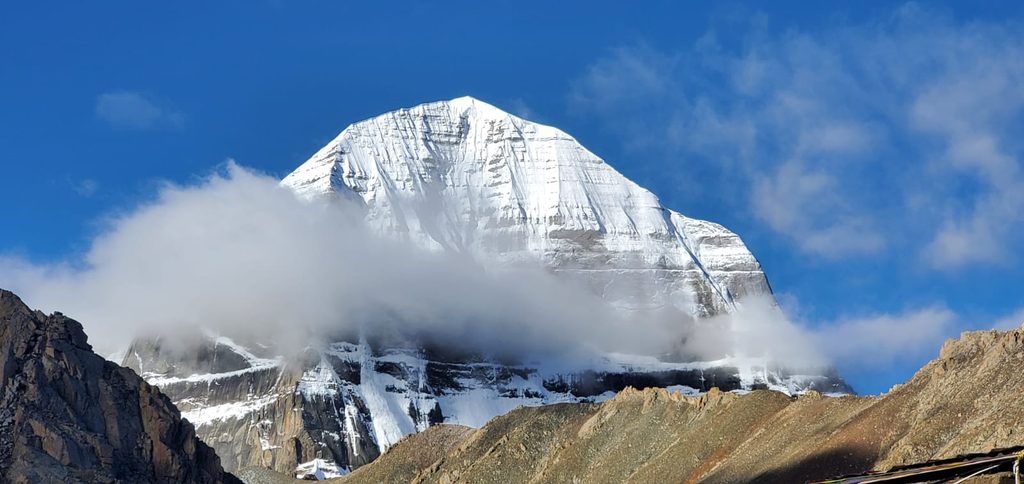
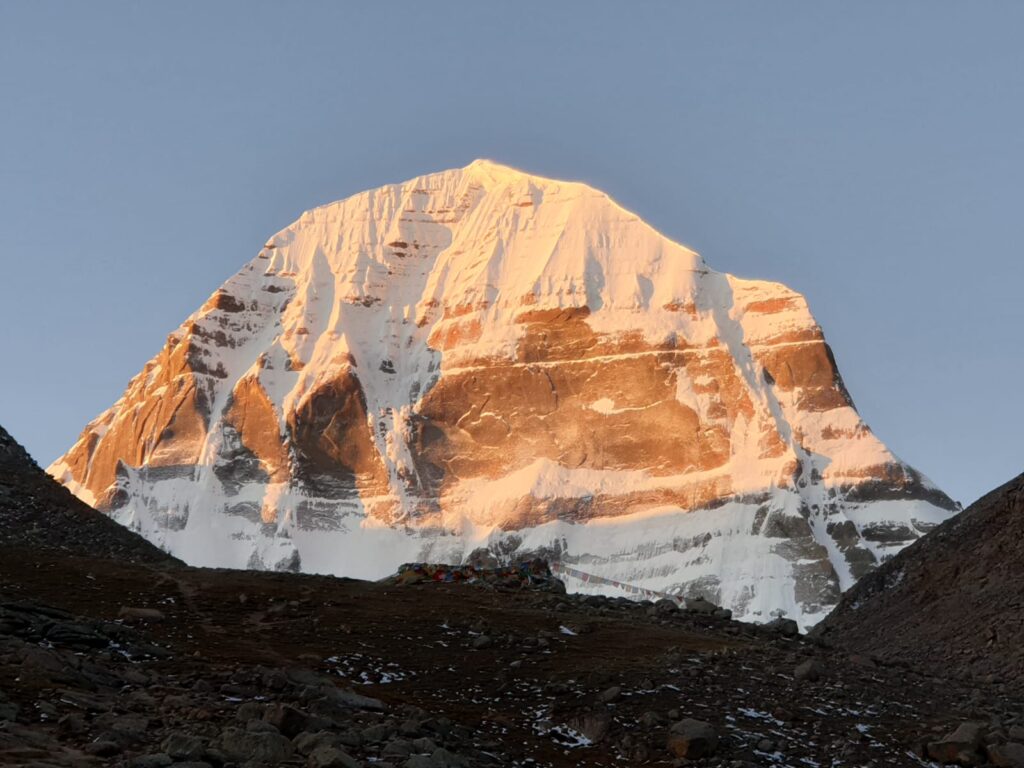
Mount Kailash Yatra — where sunlight touches the sacred, and the mountain touches the sky.
Where Is Mount Kailash?
Mount Kailash sits in Burang County, Ngari Prefecture, in the far western part of the Tibet Autonomous Region, near the sacred Lake Manasarovar. It’s remote even by Tibetan standards — the nearest service town, Darchen, sits at around 4,600–4,700 meters and serves as the starting and ending point for the kora.
Getting there is part of the undertaking itself: from Lhasa, the overland journey to Darchen typically takes several days, passing through Shigatse and Saga across the high plateau of western Tibet.
Outer Kora vs. Inner Kora
Outer Kora
Inner Kora
Distance
~52 km
~34 km
Duration
Typically 3 days
Longer, more technical
Difficulty
Moderate to challenging
Significantly harder
Highest point
Dolma La Pass, ~5,630m
Similar or higher, varies by route
Access for foreign travelers
Standard part of most tours
Currently restricted — access has been limited to a short section near Selung Monastery in recent years
Traditional belief
The standard pilgrimage circuit
Traditionally meant to be walked only after completing the Outer Kora 13 times
For almost all travelers, “doing the Kailash Kora” means the Outer Kora. The Inner Kora is a separate, far more demanding undertaking, and access rules for foreign trekkers have changed in recent years — always confirm current restrictions with your operator before planning around it.
The Outer Kora Route, Day by Day
A standard 3-day Outer Kora breaks down roughly like this:
Day 1: Darchen to Dirapuk (approx. 20 km) A relatively gentle start following the Lha Chu valley, with your first close-up views of Kailash’s north face. Overnight at Dirapuk Monastery guesthouse, around 4,900m.
Day 2: Dirapuk to Zutulpuk via Dolma La Pass (approx. 22 km) The hardest day by far. This involves a steep pre-dawn climb to Dolma La Pass at roughly 5,630–5,663 meters — the high point of the entire kora — followed by a long descent to Zutulpuk. Most trekkers start walking in the dark to reach the pass by mid-morning, before winds pick up.
Day 3: Zutulpuk back to Darchen (approx. 10 km) A shorter, easier final day back to Darchen, where most travelers rejoin their vehicle for the next leg of their Tibet itinerary.
Some travelers and pilgrims complete the entire kora in a single very long day, but this is a serious physical undertaking and not recommended for most first-time visitors.
How Difficult Is the Kailash Kora?
Most of the trek takes place above 4,500 meters, and the Dolma La Pass crossing at over 5,600m is genuinely demanding — the air there holds roughly half the oxygen available at sea level. That said, it’s generally rated as a moderate to challenging trek, not an extreme mountaineering expedition. You’re walking, not climbing, and porters or yaks can carry your gear on most organized tours.
The real challenge isn’t technical skill — it’s altitude. Good acclimatization before you arrive at Darchen makes a much bigger difference to how the kora feels than raw fitness does.
Factors that affect difficulty:
Altitude and thinner air, especially at Dolma La Pass
Cold temperatures, which can drop well below freezing at night even outside winter
Multiple consecutive days of walking after an already long overland journey to reach Darchen
Unpredictable mountain weather, including sudden snowfall even in warmer months
For more on preparing your body for the altitude specifically, see our guide to altitude sickness in Tibet.
What Permits Do You Need for Mount Kailash?
Because Ngari Prefecture is a sensitive border region, a Kailash trip requires more paperwork than a standard Lhasa-only Tibet trip:
Chinese Visa (or confirmed visa-free eligibility, depending on your nationality)
Tibet Travel Permit (TTP) — required for all foreign travelers entering the Tibet Autonomous Region
Alien’s Travel Permit (ATP) — for travel outside the “open” areas around Lhasa
Military Area Entry Permit — specifically required for Ngari Prefecture, given its proximity to international borders
None of these can be arranged independently. All are processed through a licensed Tibet travel agency on your behalf, which is also why unguided, independent travel to Kailash isn’t possible for foreign visitors.
Processing time: Plan for roughly 30 days for the full permit package, though this can run longer during peak pilgrimage periods or for travelers from certain countries. Indian travelers, for example, often need 45+ days given additional group visa requirements when entering via Nepal.
May through September is the main season, when roads across western Tibet are most reliably accessible and weather is at its most stable. Within that window, Saga Dawa — a major Tibetan Buddhist festival typically falling in May or June — is an especially popular time to go, drawing large numbers of pilgrims to circle the mountain during its most spiritually significant period of the year.
Outside the May–September window, western Tibet’s weather turns considerably harsher, with heavier snow risk on Dolma La Pass and colder overnight temperatures throughout. Exact opening dates for the kora can shift year to year, so it’s worth confirming current-season timing with your travel agency rather than assuming it matches a previous year.
How Long Does a Full Kailash Trip Take?
The kora itself is 3 days, but very few travelers go to Kailash and nothing else — the region is too remote to justify a short visit, and most itineraries build in the wider journey and nearby highlights.
Group joining tour from Kathmandu (via the Kerung/Gyirong border): typically around 10 days, our most popular and most affordable option, with fixed departures and travelers sharing transport, guide, and permit costs as a group
Fuller itineraries from Kathmandu or Lhasa: up to 14 days, often adding a Lhasa city combo, extra acclimatization days, or more time at Lake Manasarovar
Starting and ending in Lhasa: typically 13–18 days if also including Everest Base Camp or the Guge Kingdom ruins
Almost all itineraries include Lake Manasarovar, considered sacred in its own right and located near Kailash, with time built in for rituals, meditation, or simply taking in the lake before starting the kora at Darchen.
What a Typical 10-Day Group Joining Itinerary Looks Like
Kathmandu (1,400m) → Kerung (2,200m), 145 km
Acclimatization day in Kerung (2,200m)
Kerung → Saga (4,600m)
Saga → Lake Manasarovar (4,560m), 560 km / approx. 7 hours — first views of Mount Kailash
Manasarovar → Darchen (4,560m), 30 km — kora preparation
Darchen → Dirapuk (4,900m) — Kora Day 1
Dirapuk → Zutulpuk (4,790m) via Dolma La Pass, 5,630m, 22 km / approx. 10 hours — Kora Day 2, the hardest day
Zutulpuk → Darchen → Saga — Kora Day 3, then the return drive begins
Saga → Kerung
Kerung → Kathmandu (1,400m)
Typical group joining packages include Tibet Travel Permit and Alien’s Travel Permit processing, guesthouse and hotel accommodation, an experienced Tibetan guide, ground transportation, and emergency oxygen support — with meals beyond breakfast, insurance, and the China Group Visa fee usually handled separately.
What to Pack for the Kailash Kora
Warm, layered clothing — temperatures can drop below -10°C (14°F) at night even outside deep winter
Sturdy, well broken-in trekking boots
A good sleeping bag rated for cold conditions, since guesthouse bedding along the route is basic
Trekking poles, which help significantly on the Dolma La ascent and descent
Sun protection — UV exposure at this altitude is intense even in cold weather
A basic first-aid kit and any personal medication, discussed in advance with your doctor
Frequently Asked Questions
Can I do the Kailash Kora independently, without a guide? No. Foreign travelers cannot enter Tibet or the Kailash region independently. A licensed Tibet travel agency must arrange your permits and guide throughout the trip.
How hard is the Kailash Kora compared to other treks? It’s considered moderate to challenging rather than extreme — the main difficulty comes from altitude rather than technical climbing. Reasonably fit travelers who acclimatize properly generally complete it without major issues.
Can I visit the Inner Kora as a foreign traveler? Access has been restricted in recent years, with only a short section near Selung Monastery typically open to foreign visitors. Rules change, so confirm current access with your operator before planning around it.
Do I need previous trekking experience for Mount Kailash? No prior technical trekking experience is required, but reasonable physical fitness and, most importantly, proper altitude acclimatization beforehand make a significant difference.
What’s the highest point on the Kailash Kora? Dolma La Pass, at roughly 5,630–5,663 meters, on Day 2 of the standard 3-day route.
Is Mount Kailash the same as the Kailash Mansarovar Yatra? They’re closely related. “Kailash Mansarovar Yatra” is commonly used, especially by Indian pilgrims, to describe the broader pilgrimage that includes both the kora around Mount Kailash and a visit to nearby Lake Manasarovar. Yatra routes can also approach from different directions (including via India), while this guide focuses on the Tibet-side route via Lhasa or Kathmandu.
How far in advance should I book a Kailash trip? Given permit and visa processing time, booking at least 30–45 days ahead is recommended, and earlier is better during peak season, since fixed-departure group tours can fill up.
Can beginners or older travelers do the Kailash Kora? Many travelers across a wide age range complete the kora successfully. The key factors are proper acclimatization, a realistic pace, and not rushing the itinerary — not age or elite fitness. Travelers who’d rather not trek can also stay at Darchen while the rest of their group completes the kora.
How much does a Mount Kailash tour cost? A group joining tour from Kathmandu typically runs USD 2,000–3,500 per person, depending on group size, accommodation standard, and season. This usually covers permits, guide, transport, and accommodation, with meals beyond breakfast, insurance, and visa fees charged separately.
Planning a Trip to Mount Kailash?
A Kailash journey involves more moving parts than a standard Tibet trip — permits, acclimatization planning, and a realistic itinerary length all matter for a trip this remote. If you’d like to see full pricing, fixed departure dates, and the detailed day-by-day itinerary, take a look at our Mt Kailash Group Joining Tour 2027, our 10-day fixed-departure pilgrimage from Kathmandu.
Otherwise, send us an inquiry with your travel dates, nationality, and whether you’d prefer to start from Lhasa or Kathmandu, and we’ll help you find or customize a Kailash itinerary that fits your trip.
Quick answer: Altitude sickness is common in Tibet because most of the region sits above 3,000 meters (9,800 ft), including Lhasa at 3,650m. Most travelers experience mild symptoms — headache, fatigue, shortness of breath — in the first 24–48 hours, which typically resolve with rest and slow acclimatization. Severe altitude sickness is uncommon when travelers ascend gradually, stay hydrated, and avoid overexertion on arrival, but it can be serious if ignored. Anyone in reasonably good health can visit Tibet safely with the right precautions.
What Is Altitude Sickness?
Altitude sickness, medically known as Acute Mountain Sickness (AMS), happens when your body hasn’t yet adjusted to reduced oxygen levels at high elevation. It typically starts affecting people above 2,500–3,000 meters, and Tibet’s average elevation is over 4,000 meters, so it’s a genuine consideration for nearly every visitor, not just trekkers.
Importantly: altitude sickness has nothing to do with fitness level or age. A marathon runner in their twenties can be hit harder by AMS than a sedentary traveler in their sixties. Your body’s response to reduced oxygen is largely individual and can’t be predicted by how fit you are.
How High Is Tibet, Exactly?
Location
Elevation
Lhasa
3,650m / 11,975 ft
Gyantse
4,040m / 13,255 ft
Shigatse
3,840m / 12,600 ft
Nyingchi
3,000m / 9,840 ft
Namtso Lake
4,730m / 15,520 ft
Everest Base Camp (Tibet side)
5,150–5,200m / 16,900–17,060 ft
Mount Kailash area
4,575m / 15,010 ft
For reference, elevation is generally categorized as:
High altitude: 2,400–3,650m
Very high altitude: 3,650–5,500m
Extreme altitude: above 5,500m
That means most of a standard Tibet itinerary falls into “very high altitude” territory, which is exactly why acclimatization planning matters.
Symptoms of Altitude Sickness
Mild symptoms (most common, usually appear within 6–12 hours of arrival):
Headache
Fatigue or general weakness
Shortness of breath, especially with exertion
Dizziness
Nausea or loss of appetite
Difficulty sleeping
Severe symptoms (rare, but require immediate medical attention and descent):
Confusion or loss of coordination
Severe shortness of breath, even at rest
Coughing up frothy or pink-tinged fluid
Chest tightness
Bluish lips or fingertips
Severe cases can progress to High Altitude Pulmonary Edema (HAPE) or High Altitude Cerebral Edema (HACE), both of which are medical emergencies requiring immediate descent and treatment. These are uncommon among travelers who acclimatize properly, but they’re the reason altitude sickness should always be taken seriously rather than pushed through.
When Does Altitude Sickness Start?
Symptoms typically don’t appear immediately. Most travelers start noticing mild effects 4 to 12 hours after arrival — so if you land in Lhasa in the early afternoon feeling fine, don’t be surprised if a headache shows up that evening or the next morning. This delayed onset is exactly why the first day or two in Lhasa should be kept low-key regardless of how you feel on arrival.
How to Prevent Altitude Sickness in Tibet
1. Give yourself time to acclimatize in Lhasa
Plan to spend at least 2–3 days in Lhasa before heading to higher elevations like Everest Base Camp or Kailash. This is the single most effective thing you can do.
2. Take it easy on day one
Avoid strenuous activity, alcohol, and heavy meals during your first 24–48 hours. Short walks are fine — mountaineering-style exertion is not.
3. Stay hydrated
Dehydration worsens altitude symptoms. Drink more water than usual and go easy on caffeine and alcohol, both of which contribute to dehydration.
4. Consider taking the train instead of flying
Flying into Lhasa means an abrupt jump from sea level to 3,650m in a couple of hours. The train from Xining or Chengdu ascends more gradually and gives your body more time to adjust en route, though it’s not a substitute for proper acclimatization once you arrive.
5. Talk to your doctor before you go
If you have any heart, lung, or circulatory conditions, or a history of severe altitude sickness, speak with a doctor before booking. They may recommend preventive medication such as acetazolamide (Diamox), which is commonly used by travelers to speed up acclimatization — but this should be discussed with and prescribed by a physician, not self-administered based on travel blogs.
6. Know your itinerary’s altitude profile
A well-designed Tibet itinerary builds in acclimatization days and avoids jumping straight from Lhasa to extreme elevations like Everest Base Camp. This is one of the most important — and most overlooked — reasons to book with an experienced local operator rather than piecing together your own fast-paced route.
What to Do If You Experience Symptoms
If symptoms are mild (headache, mild fatigue, slight nausea):
Rest, hydrate, and avoid further ascent until symptoms improve
Over-the-counter pain relief can help with headaches
Most mild AMS resolves within 24–48 hours as your body adjusts
If symptoms don’t improve or worsen:
Don’t continue ascending
Tell your guide immediately — Tibet tour guides are experienced in recognizing and managing AMS and can arrange oxygen, medical support, or descent
Descending even a few hundred meters can bring significant relief
If symptoms are severe (confusion, extreme breathlessness, chest tightness):
This is a medical emergency
Immediate descent and medical attention are required
Your guide should coordinate this without delay — never try to push through severe symptoms
Most hotels in Lhasa and other high-altitude towns in Tibet offer supplemental oxygen, and reputable tour operators travel with basic oxygen and emergency protocols as standard practice.
Who Is More at Risk?
While anyone can be affected regardless of fitness or age, a few factors raise the risk of earlier or more intense symptoms:
A history of altitude sickness on previous trips
Pre-existing heart, lung, or respiratory conditions
Ascending too quickly without acclimatization stops
Traveling with a cold, respiratory infection, or general fatigue
Heavy alcohol consumption on arrival
If any of these apply to you, it’s worth building extra acclimatization time into your itinerary and discussing your trip with a doctor beforehand.
Frequently Asked Questions
Is altitude sickness common in Tibet? Yes — mild symptoms are common given that most of Tibet sits above 3,000m. Most travelers experience some mild effects in the first day or two, which typically resolve with rest and acclimatization.
Can altitude sickness be dangerous? Mild AMS is uncomfortable but not dangerous. Severe altitude sickness (HAPE or HACE) is a medical emergency, but it’s uncommon among travelers who acclimatize properly and don’t push through worsening symptoms.
Do I need to be fit to avoid altitude sickness in Tibet? No. Fitness level doesn’t reliably predict who gets altitude sickness. Even very fit travelers can experience symptoms, while some less active travelers feel fine.
Is Lhasa high enough to cause altitude sickness? Yes. At 3,650m, Lhasa is well within the range where AMS commonly occurs, which is why most itineraries include a few acclimatization days there before heading further.
Should I take Diamox before traveling to Tibet? Diamox (acetazolamide) is commonly used to help with acclimatization, but it’s a prescription medication and should only be taken on a doctor’s advice, factoring in your medical history.
Is it safer to take the train or fly to Lhasa? The train allows for a more gradual ascent, which some travelers find easier on the body, but it doesn’t replace proper acclimatization once you arrive. Flying is faster but means a more abrupt altitude change.
Can children or older travelers visit Tibet safely? Generally yes, with the same precautions as any traveler — gradual acclimatization, hydration, and monitoring for symptoms. Speak with a doctor beforehand if there are underlying health concerns.
How long does altitude sickness last? Mild symptoms typically improve within 24–48 hours as the body acclimatizes. If symptoms persist or worsen beyond this window, it’s a signal to stop ascending and seek guidance from your guide or a doctor.
This article is for general travel planning purposes and isn’t a substitute for medical advice. If you have underlying health conditions, talk to your doctor before your trip.
Planning a Trip to Tibet?
A well-paced itinerary with proper acclimatization built in is one of the biggest factors in avoiding altitude sickness — it’s not just about willpower or fitness. If you’d like help designing a route that balances your must-see destinations with safe acclimatization, send us an inquiry with your travel dates and the places you want to visit, and we’ll help you build an itinerary that keeps you comfortable at altitude.
One of the most common points of confusion for first-time Tibet travelers is the difference between a China visa and a Tibet Travel Permit. Many people search for a “Tibet visa,” but technically no such document exists — what you actually need is a combination of the two, and they serve completely different purposes.
Get this wrong and you could end up with a valid Chinese visa but no way to actually reach Lhasa, or vice versa. Here’s exactly how the two fit together.
The Short Answer
A China visa (or visa-free entry, if your passport qualifies) gets you into mainland China.
A Tibet Travel Permit gets you into the Tibet Autonomous Region specifically.
You generally need both. They’re issued by completely different authorities, through different processes, and one doesn’t substitute for the other.
China Visa: Your Entry Ticket to the Country
For most nationalities, entering China requires an “L” category tourist visa, arranged through a Chinese embassy or consulate before departure. This visa is your general permission to be in mainland China — it says nothing about Tibet specifically.
An important, often-repeated piece of advice from experienced Tibet agencies: don’t mention Tibet on your Chinese visa application. This sounds counterintuitive, but it avoids a bureaucratic catch-22 — some embassies, on seeing “Tibet” listed as a destination, will ask to see your Tibet Travel Permit before approving the visa. The problem is that your Tibet Travel Permit application can’t move forward until you already have a valid Chinese visa. Rather than get stuck in that loop, most travelers list mainstream Chinese cities on their entry city (Beijing, Chengdu, Xi’an, or Shanghai are common choices) and let their Tibet agency handle Tibet-specific documentation separately.
What About Visa-Free Entry?
China has significantly expanded visa-free access in recent years. As of 2026, passport holders from roughly 78 countries can enter China visa-free for stays of up to 30 days, covering tourism, business, and family visits. This visa-free policy does apply to travelers heading onward to Tibet.
However, there’s a separate 240-hour (10-day) visa-free transit policy, available to around 55 nationalities, meant for travelers passing through China en route to a third country. It’s worth knowing that this transit policy specifically excludes Tibet — you cannot use it to visit the Tibet Autonomous Region, even if your passport otherwise qualifies.
The bigger point either way: whether you enter China visa-free or on a standard tourist visa, neither one removes the requirement for a separate Tibet Travel Permit.
Tibet Travel Permit: Your Entry Ticket to Tibet
The Tibet Travel Permit (TTP), issued by the Tibet Tourism Bureau, is what actually authorizes you to enter and travel within the Tibet Autonomous Region. It’s a physical document — typically a two-page A4 sheet listing your name, passport details, and approved itinerary — and airlines and train staff will check for the original before letting you board a flight or the train to Lhasa.
A few things that make it fundamentally different from a visa:
It can’t be applied for independently. Only a licensed Tibet travel agency can submit the application on your behalf, which is also why independent, unguided travel in Tibet isn’t possible for foreign visitors.
It’s tied to a specific itinerary. Unlike a visa, which broadly permits travel around the country, the TTP only covers the exact route and dates your agency registers.
It’s not reusable. At the end of your trip, the original permit is typically collected and returned to the Tibet Tourism Bureau — you can’t use the same one for a future trip.
There’s usually no separate fee. The cost of arranging the TTP is generally bundled into your tour booking rather than charged as a standalone government fee.
Side-by-Side Comparison
China Visa
Tibet Travel Permit
Issued by
Chinese Embassy/Consulate (or visa-free policy)
Tibet Tourism Bureau
Covers
Entry into mainland China
Entry into the Tibet Autonomous Region
Who applies
You, directly (or automatically if visa-free)
Your licensed Tibet travel agency
Reusable
Yes, within its validity window
No, single-trip only
Required for Tibet?
Yes (or valid visa-free status)
Yes, always
Can be arranged independently?
Yes
No
Does the Order Matter?
Yes. In almost all cases, you need your Chinese visa (or confirmed visa-free eligibility) sorted out before your agency can begin the Tibet Travel Permit application. The typical sequence looks like this:
Book your Tibet tour with a licensed agency and confirm your itinerary.
Apply for your Chinese visa (or confirm your visa-free eligibility), without listing Tibet as your destination.
Send your agency a scanned copy of your passport and visa.
Your agency submits the Tibet Travel Permit application to the Tibet Tourism Bureau.
The physical permit is delivered to you (usually to your hotel in mainland China) before you depart for Lhasa.
What If You’re Entering From Nepal?
The process shifts slightly for travelers entering Tibet overland or by air from Kathmandu. Rather than an individual tourist visa, most travelers in this situation need a China Group Visa, arranged in Kathmandu, which typically requires a minimum group size to process. Your Tibet Travel Permit is then issued and handed over by your operator’s partner agency in Nepal before you cross the border or board your flight to Lhasa.
Frequently Asked Questions
Is there such a thing as a “Tibet visa”? Not officially. Tibet is part of China, so there’s no separate visa category for it. What people usually mean by “Tibet visa” is the Tibet Travel Permit, combined with a standard Chinese visa.
If my passport is visa-free for China, do I still need a Tibet Travel Permit? Yes. Visa-free entry to China only addresses the China visa side of things — the Tibet Travel Permit is still mandatory regardless of your visa status.
Can I use China’s 240-hour transit visa-free policy to visit Tibet? No. That specific transit policy explicitly does not cover the Tibet Autonomous Region.
Should I tell the embassy I’m visiting Tibet when applying for my Chinese visa? Most experienced agencies advise against it, to avoid a documentation catch-22 where the embassy wants to see a permit you can’t yet obtain. List other mainland Chinese cities instead and let your Tibet operator handle the Tibet-specific side.
Can I apply for the Tibet Travel Permit before I get my Chinese visa? Generally no — your agency needs a copy of your approved visa (or confirmation of your visa-free status) before they can submit the Tibet Travel Permit application.
Do I need a new Tibet Travel Permit if I visit Tibet twice? Yes. The permit is single-trip only and is not reused for future visits, even if you’re returning within the same visa’s validity.
Sorting This Out Before You Book
Because visa rules vary by nationality and change periodically, the safest move is to confirm your specific requirements with your travel agency before purchasing flights. Send us an inquiry with your nationality and travel dates, and we’ll walk you through exactly which visa applies to you, how to time your Chinese visa alongside the Tibet Travel Permit application, and what to expect at each step.
If you’re planning a Tibet tour, the Tibet Travel Permit is the single most important document you’ll need to sort out before you go. It’s different from a Chinese visa, it can’t be applied for on your own, and depending on your route you may actually need more than one permit stacked on top of each other.
This guide breaks down exactly what the Tibet Travel Permit is, which other permits you might need for places like Everest Base Camp or Mount Kailash, how the timeline works, and what documents you’ll need to provide.
What is the Tibet Travel Permit?
The Tibet Travel Permit (TTP) also called the Tibet Entry Permit or TTB Permit is an official document issued by the Tibet Tourism Bureau that allows non-Chinese passport holders to enter and travel within the Tibet Autonomous Region.
It functions as your entry pass into Tibet, separate from your Chinese visa. You cannot board a flight or train to Lhasa without the original physical permit in hand (for flights) or printed copies (for the train).
A few key facts about the TTP:
It’s required for essentially all foreign passport holders, regardless of whether you enter via Beijing, Chengdu, Xining, or from Nepal
It can only be arranged through an authorized Tibet travel agency there’s no way to apply for it as an independent traveler
It typically arrives as a two-page A4 document
It only covers the specific itinerary and areas you’ve registered travel outside your approved route generally requires additional permits
The Different Types of Permits You May Need
This is where a lot of first-time travelers get confused. The Tibet Travel Permit is the base requirement, but depending on where your itinerary takes you, additional permits may stack on top of it.
Permit
Issued By
Needed For
Who Applies
Tibet Travel Permit (TTP)
Tibet Tourism Bureau
Entering Tibet at all
Your travel agency, before departure
Alien’s Travel Permit (ATP)
Public Security Bureau (PSB)
Restricted areas outside Lhasa
Your guide, usually after you arrive in Lhasa
Military Area Entry Permit
Military authorities
Sensitive border regions
Your travel agency, well in advance
Foreign Affairs Permit
Foreign Affairs Office
Certain border/expedition routes
Your travel agency, well in advance
Frontier Pass / Border Permit
Foreign Affairs Office, Lhasa
Areas near the Nepal border
Your travel agency, in advance
Tibet Travel Permit (TTP)
This is the permit everyone needs. It’s your baseline authorization to enter the Tibet Autonomous Region at all, whether by air, train, or overland from Nepal.
Alien’s Travel Permit (ATP)
Also known as the PSB Permit, this one is required once you leave Lhasa and head toward areas outside the “open” cities. Historically this included places like Everest Base Camp and Shigatse, though the exact list of areas requiring this permit has changed over time — some regular tourist routes to Everest Base Camp and Gyirong, for example, no longer required it as of mid-2025. Since rules like this shift, it’s worth confirming the current requirement for your specific route with your operator rather than relying on an older blog post.
Where the ATP is still required, the good news is that it’s usually processed quickly and inexpensively after you land in Lhasa — your guide handles the paperwork with the local PSB office.
Military Area Entry Permit
If your route includes genuinely sensitive or remote border regions — Mount Kailash in the Ngari Prefecture is the classic example — you’ll also need a military permit. This one can’t be picked up on arrival; it needs to be submitted well before your trip, often 20+ days in advance.
Foreign Affairs Permit
Reserved for specific border areas, research-style visits, or unusual expedition routes. Not every traveler will need this, but it’s worth asking about if your itinerary is off the beaten path.
Frontier Pass / Border Permit
If you’re heading toward the Nepal border — for a Kathmandu–Lhasa overland trip, or a Kailash/Manasarovar route that approaches the border — a separate frontier or border permit is typically required, arranged through the Foreign Affairs Office in Lhasa.
Do You Need All of These Permits?
Not necessarily. It depends entirely on your itinerary.
Lhasa only: Tibet Travel Permit alone is generally sufficient.
Lhasa + Everest Base Camp: TTP, and possibly an Alien’s Travel Permit depending on current route rules.
Lhasa + Mount Kailash / Lake Manasarovar: TTP, Alien’s Travel Permit, and Military Permit, since Ngari Prefecture is considered a sensitive border region.
Kathmandu–Lhasa overland or border-crossing routes: TTP plus a Frontier/Border Permit, in addition to whichever of the above apply to the rest of your route.
This is exactly why a fixed, confirmed itinerary matters before your agency starts the permit process — the permits are matched to your specific route, not issued as a blanket document.
Timeline: When to Start the Process
Permit processing takes time, and delays do happen, so starting early gives your agency room to troubleshoot if something doesn’t go smoothly.
A rough timeline for a standard Lhasa + Everest itinerary looks like this:
2–3 months before departure: Confirm your itinerary and book with a licensed Tibet travel agency. This is when the permit clock effectively starts.
Around 20–45 days before departure: Your agency submits your documents (passport and visa copies) for the Tibet Travel Permit, and, if applicable, begins the Military Permit process for more remote routes.
Roughly 30–40 days before departure: TTP is typically approved.
On arrival in Lhasa: Your guide arranges the Alien’s Travel Permit, if your route requires one, usually processed within hours for a small fee.
For a Kailash or other remote western Tibet itinerary, it’s sensible to start the whole process at least three months out, given the extra permits and the possibility of delays tied to broader diplomatic or border conditions.
What Documents Do You Need to Provide?
Requirements vary slightly depending on your passport and visa type, but in general your agency will ask for:
A scanned copy of your passport’s photo page (valid for at least six months beyond your travel dates)
A copy of your Chinese visa (typically an “L” tourist visa)
If you hold a different visa type study (X), work (Z), or a China residence permit you may need to provide supporting documents such as a study or work certificate
A contact address in mainland China (often your hotel) where the physical permit can be delivered before you fly to Tibet
If you’re entering via Nepal, the process has an extra step: most travelers need a China Group Visa issued in Kathmandu rather than a visa obtained elsewhere, since visas from other cities generally aren’t valid for that entry route (visa-free travelers are the main exception). Your Tibet Travel Permit is then delivered by your operator’s local partner in Kathmandu.
Special Cases
Diplomats, journalists, and government officials cannot get a Tibet Travel Permit through a regular travel agency. Their applications must go through the Tibet Foreign Affairs Office directly.
Travelers with both a Chinese passport and Chinese ID card are treated differently using the national ID card allows travel to more areas of Tibet than a Chinese passport alone.
A Note on China’s Visa-Free Policies
China has expanded its visa-free entry policies for citizens of a growing number of countries in recent years. It’s important to understand that this doesn’t remove the need for a Tibet Travel Permit — visa-free entry into China and permission to enter Tibet are two separate questions. Even travelers who don’t need a Chinese visa at all still need the TTP to travel to Tibet.
Because visa and permit rules are updated periodically, always confirm the latest policy for your specific nationality with your travel agency before booking flights or making other non-refundable arrangements.
Frequently Asked Questions
Can I apply for a Tibet Travel Permit myself? No. It must be arranged through an authorized Tibet travel agency after you’ve confirmed a tour itinerary.
How long does it take to get a Tibet Travel Permit? Processing generally takes around 15–20 working days once your documents are submitted, though it’s best to allow more time, especially for itineraries that include additional permits.
Is there a separate fee for the Tibet Travel Permit? The TTP itself typically has no standalone official fee, since it’s bundled into your tour booking. Some agencies list associated permit costs as a separate line item.
Do I need the Alien’s Travel Permit for Everest Base Camp? It depends on your exact route and current regulations, which have changed in recent years for some standard routes. Confirm with your operator based on your specific itinerary.
Do I need a Military Permit for Mount Kailash? Yes, in addition to the Tibet Travel Permit and Alien’s Travel Permit, since the Ngari region is considered a sensitive border area.
Can I get my Tibet Travel Permit if I’m already in Nepal? Yes, but the process is slightly different — it typically involves obtaining a China Group Visa in Kathmandu, with your Tibet Travel Permit delivered through your operator’s local partner there.
What happens if my permit is delayed or denied? Delays can happen for various reasons, including diplomatic or border-related factors. An experienced agency will have contingency plans and should keep you informed rather than leaving you to find out at the airport.
Does the Tibet Travel Permit let me visit anywhere in Tibet? No. It only covers the specific itinerary you’ve registered. Traveling to additional areas, especially outside Lhasa, generally requires further permits matched to that route.
Planning Your Trip?
Because permit requirements depend on your nationality, visa type, and exact itinerary, the most useful thing you can do before booking is share these details with your travel agency early: your nationality, passport type, intended route, and travel dates. That allows the permit process to be tailored to your actual trip rather than a generic assumption.
Permit rules for Tibet change often, and getting the wrong information can mean delays or even a denied application. If you’re not sure exactly what you’ll need for your route, send us an inquiry with your nationality, passport type, and rough itinerary, and we’ll walk you through exactly which permits apply to your trip and how to time everything correctly.
A Lhasa motorbike tour is one of the most extraordinary ways to experience the Tibetan Plateau.
Instead of simply travelling across Tibet by car or bus, you experience the landscape at road level: the enormous open plateau, high mountain passes, turquoise lakes, Tibetan villages, monasteries, winding Himalayan roads and, ultimately, the spectacular north face of Mount Everest.
For riders, the attraction is not simply reaching Lhasa or Everest Base Camp. It is the journey between them.
A typical Lhasa to Everest Base Camp motorcycle tour combines time in Lhasa for acclimatization and sightseeing with several days of riding through central Tibet toward Shigatse, Tingri and the Everest region. Depending on the itinerary, riders can experience some of the highest paved roads and mountain passes accessible by motorcycle.
This guide explains what you need to know before planning a Tibet motorbike tour, including the route, permits, motorcycles, altitude, riding conditions, best time to go, accommodation, costs, physical preparation, safety, packing, and the most frequently asked questions.
The goal is simple: help you decide whether a Tibet motorcycle adventure is right for you before you book it.
What Is a Lhasa Motorbike Tour?
A Lhasa motorbike tour is a guided motorcycle journey through Tibet, usually beginning in Lhasa and continuing toward destinations such as Shigatse and Everest Base Camp.
For international travelers, Tibet is not a destination where you can normally organize an independent motorcycle road trip in the same way you might in Nepal, India or Europe. Tibet travel involves specific permits and organized travel arrangements, and foreign visitors need to work with an authorized travel operator for the required Tibet travel documentation.
A typical Lhasa–Everest Base Camp motorcycle itinerary may include:
Lhasa
Potala Palace
Jokhang Temple
Barkhor Street
Yamdrok Lake or other high-altitude landscapes depending on the route
Gyantse
Shigatse
Tashilhunpo Monastery
Tingri or the Everest region
Rongbuk Monastery
North Everest Base Camp
Himalayan mountain passes
Views of Mount Everest
The exact route, riding days, road conditions and permits can change, so your final itinerary should always be confirmed before departure.
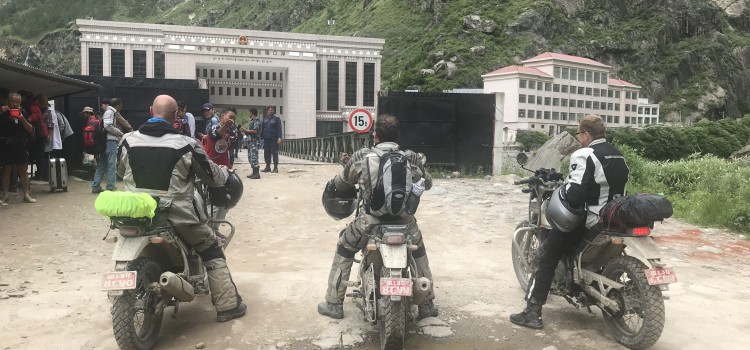
Riders waiting in border during paper work for Lhasa motorbike tour
Why Ride a Motorcycle to Lhasa and Everest Base Camp?
There are many ways to travel through Tibet, but a motorcycle provides a completely different experience.
From the saddle, you are exposed to the landscape rather than separated from it by a vehicle window.
You can stop for photographs, experience changes in temperature and wind, hear the road and surroundings, and appreciate the enormous scale of the Tibetan Plateau.
For experienced riders, the journey can be as important as the destination.
The major attractions include:
1. Riding across the Tibetan Plateau
Tibet offers vast open landscapes unlike most conventional motorcycle destinations.
2. High-altitude mountain passes
Some routes cross passes above 5,000 metres, creating a riding environment that requires preparation and respect.
3. Mount Everest from the north
The Tibetan side provides a spectacular perspective of Everest and the surrounding Himalayan range.
4. Lhasa
The journey normally begins with time in Lhasa, allowing riders to experience Tibet’s cultural and historical heart before heading into the mountains.
5. Tibetan monasteries and culture
The route can combine motorcycle riding with visits to major monasteries, historic sites and traditional Tibetan settlements.
6. The sense of expedition
A Tibet motorcycle trip feels more like an expedition than a conventional holiday.
Lhasa to Everest Base Camp by Motorcycle: What Is the Route Like?
One of the most popular concepts for an adventure rider is:
The precise itinerary can vary, but the journey generally progresses from Lhasa toward central Tibet and then west toward the Everest region.
A representative route looks like this:
Day 1 – Arrival in Lhasa
Arrive in Lhasa and transfer to your hotel.
There is normally no need to ride on arrival day. The priority is rest and beginning the acclimatization process.
Lhasa sits at approximately 3,650 metres above sea level, so even walking around the city can feel more tiring than expected.
Day 2 – Lhasa Sightseeing and Acclimatization
Spend the day exploring Lhasa.
Typical attractions include:
Potala Palace
Jokhang Temple
Barkhor Street
Sera Monastery
Norbulingka
This is also an important acclimatization day.
Do not underestimate it.
You may feel healthy at sea level and still experience headache, breathlessness, poor sleep or fatigue after arriving in Lhasa.
Day 3 – Lhasa / Motorcycle Preparation
Depending on the tour design, this day can be used for further sightseeing, motorcycle briefing, paperwork, equipment checks and preparation for the road journey.
This is a good opportunity to:
Check the motorcycle
Test riding position
Organize luggage
Confirm emergency procedures
Meet the guide and support team
Discuss the riding schedule
Review the route
Day 4 – Lhasa to Gyantse
The journey begins.
The landscape changes quickly as you leave Lhasa behind and enter the open Tibetan Plateau.
Depending on the exact route, riders may encounter high mountain passes and dramatic Himalayan scenery.
This is when the motorcycle experience really begins.
Day 5 – Gyantse to Shigatse
The journey continues toward Shigatse.
Gyantse is historically significant and is known for Pelkor Chode Monastery and Gyantse Dzong.
Shigatse is one of the major cities of Tibet and is home to Tashilhunpo Monastery.
Day 6 – Shigatse toward Tingri / Everest Region
The landscape becomes increasingly remote.
Open plains, enormous mountain horizons and increasingly high-altitude terrain dominate the route.
Riders should expect a full riding day rather than a short sightseeing transfer.
Day 7 – Tingri to Everest Region
The road continues toward Mount Everest.
This is one of the most anticipated parts of the entire trip.
As the Himalayas become increasingly prominent, riders begin to appreciate why the north-side Everest route is so popular with adventure motorcyclists.
Day 8 – Everest Base Camp
The highlight of the trip.
The Tibetan side of Everest offers a dramatic view toward the world’s highest mountain.
The exact location where motorcycles are permitted and the final transport arrangements around the Everest Base Camp area can depend on current local regulations, so your operator should confirm the latest access rules before departure.
Return Journey
The return can follow the same general route or a modified itinerary depending on the tour.
Some motorcycle itineraries continue toward Nepal and Kathmandu, while others return to Lhasa or conclude elsewhere in Tibet.
How Many Days Do You Need for a Lhasa Motorcycle Tour?
A comfortable Lhasa–Everest motorcycle journey generally needs more than just a few riding days.
You need to allow time for:
Arrival
Acclimatization
Lhasa sightseeing
Motorcycle preparation
Riding
Rest
Weather
Road conditions
Everest Base Camp
Permit and checkpoint logistics
A trip of around 10–14 days is a practical range for many Lhasa–Everest motorcycle itineraries.
Longer journeys are possible if you want to include:
Kathmandu
Nepal–Tibet border crossing
Mount Kailash
Lake Manasarovar
Namtso
Western Tibet
Additional Tibetan monasteries
Additional rest/acclimatization days
Can You Ride a Motorcycle from Kathmandu to Lhasa?
Yes, Kathmandu–Lhasa motorcycle tours are a popular form of Himalayan overland adventure, but they are more complicated than simply renting a motorcycle in Nepal and crossing the border.
A Kathmandu–Tibet motorcycle expedition involves international border procedures, Tibet travel permits, vehicle and rider documentation, and organized travel arrangements.
The route commonly enters Tibet through the Gyirong/Rasuwagadhi border area before continuing toward the Tibetan Plateau.
A Kathmandu–Lhasa–Everest Base Camp motorcycle journey can therefore combine:
or the reverse, depending on the itinerary and border arrangements.
If you are particularly interested in riding from Nepal, ask your tour operator about the current border-entry requirements before making flights or other non-refundable arrangements.
Can Foreigners Ride Motorcycles in Tibet?
Foreign travelers can participate in organized motorcycle tours in Tibet, but the process is different from simply renting a motorcycle and travelling independently.
Foreign travelers require the appropriate Tibet travel documentation and must follow the organized travel requirements applicable to their nationality and route. Tibet Travel Permit arrangements are normally handled through a qualified Tibet travel agency.
Motorcycle tours may also require additional riding documentation, temporary driving authorization and vehicle-related paperwork.
These requirements can change, so riders should not rely on an old blog post or forum discussion when preparing their documents.
Always confirm the current requirements for your nationality, entry point and motorcycle itinerary before departure.
Do You Need a Tibet Travel Permit for a Motorbike Tour?
Yes, international travelers generally need a Tibet Travel Permit to enter and travel in Tibet.
The permit is also referred to as the:
Tibet Travel Permit
Tibet Entry Permit
Tibet Tourism Bureau Permit
Tibet Permit
TTB Permit
Current travel information confirms that foreign travelers require the Tibet Travel Permit and that the application is arranged through an authorized Tibet travel agency rather than as an ordinary individual tourist application.
For a motorcycle tour, your operator may also need to arrange additional permits or travel documents depending on the route.
This is particularly important if your itinerary includes:
Everest
Border areas
Western Tibet
Mount Kailash
Remote prefectures
Nepal–Tibet border crossings
What About a China Visa?
A China visa and a Tibet Travel Permit are not necessarily the same thing.
Your visa requirements depend on your nationality, current Chinese visa policy and where you enter China.
China’s visa-free policies have changed significantly in recent years, and visa rules can change again.
For example, current Tibet travel information notes that visa-free entry into China does not automatically eliminate the requirement for the Tibet Travel Permit.
Therefore, do not assume:
“I can enter China without a visa, so I can ride to Tibet without a permit.”
Those are separate questions.
What Motorcycle Is Used for a Tibet Motorcycle Tour?
The motorcycle is one of the most important decisions when planning a Tibet riding adventure.
A suitable motorcycle should be:
Reliable
Comfortable for long riding days
Capable at high altitude
Easy to control on mountain roads
Suitable for the rider’s experience
Equipped with appropriate luggage
Supported by a mechanic or support vehicle
Motorcycle models offered by operators vary.
Adventure bikes commonly used on Tibet motorcycle tours can include mid-sized motorcycles such as:
250cc–500cc adventure motorcycles
450cc-class motorcycles
650cc–800cc adventure motorcycles
Larger motorcycles are not automatically better.
At high altitude, reliability, rider confidence, handling and manageable weight can be more important than engine size.
Is a 250cc Motorcycle Enough for Tibet?
For many riders, a 250cc motorcycle can be adequate for a well-planned Tibet route.
The answer depends on:
Motorcycle model
Rider weight
Luggage
Passenger load
Road gradient
Wind
Altitude
Mechanical condition
Riding experience
At extreme altitude, every engine produces less power because the air is thinner.
Therefore, riders should not expect a motorcycle to perform at 5,000+ metres exactly as it does at sea level.
Is a 500cc or 800cc Motorcycle Better?
A larger engine can provide additional power and comfort, especially on long highway sections and when carrying luggage.
However, larger motorcycles also tend to be heavier.
That matters when:
Parking on uneven ground
Turning around on narrow roads
Managing a motorcycle at low speed
Recovering from a tip-over
Riding tired
Riding in strong wind
For many adventure riders, a middleweight motorcycle provides a good balance between power, comfort and manageability.
Do You Need Previous Motorcycle Experience?
Yes.
A Tibet motorbike tour should not be your first-ever motorcycle experience.
You should be comfortable with:
Long-distance riding
Motorcycle braking
Cornering
Hairpin turns
Riding at low speeds
Riding on mountain roads
Managing fatigue
Riding in wind
Basic motorcycle troubleshooting
Riding for several consecutive hours
Previous experience with adventure riding or touring is highly beneficial.
Off-road experience can also help, although many Tibet routes are primarily paved.
Some current motorcycle-tour operators describe their Tibet routes as mostly paved, while noting that riders should be prepared for narrow sections, potholes, road debris and occasional gravel caused by road conditions or construction.
Are Tibet Roads Suitable for Motorcycles?
Many major Tibet routes are paved and well engineered, but this does not mean they are easy roads.
You may encounter:
Hairpin bends
Long climbs
High passes
Strong crosswinds
Potholes
Construction
Gravel
Dust
Road debris
Sudden weather changes
Traffic
Livestock
Narrow mountain sections
The biggest challenge may not be the road surface.
It can be the combination of altitude + cold + wind + long riding hours + fatigue.
How Difficult Is a Lhasa to Everest Motorcycle Tour?
The tour is best considered moderate to challenging, depending on the rider and itinerary.
The motorcycle itself may not be the most difficult part.
Altitude is often the biggest challenge.
A rider who is very fit at sea level can still struggle at 4,000–5,000 metres.
You should be prepared for:
Reduced physical performance
Shortness of breath
Headaches
Fatigue
Poor sleep
Reduced concentration
And that last point is especially important.
Reduced concentration at high altitude can become a motorcycle safety issue.
Altitude on a Tibet Motorbike Tour
Altitude is one of the most important things to understand before booking a Tibet motorcycle adventure.
Approximate elevations encountered on a typical Lhasa–Everest route can include:
Location / Terrain
Approximate Elevation
Lhasa
3,650 m
Shigatse
3,800+ m
Tibetan Plateau
4,000+ m
Everest region
4,500–5,000 m
High mountain passes
5,000 m+
Exact elevations depend on the route.
Some Tibet motorcycle tours cross several passes above 5,000 metres. One current motorcycle-tour operator lists passes above 5,000 metres on its Everest route, illustrating how extreme the riding environment can become.
What Is Altitude Sickness?
Altitude sickness occurs when your body has not adequately adapted to reduced oxygen availability at high elevation.
Common symptoms can include:
Headache
Dizziness
Fatigue
Nausea
Reduced appetite
Difficulty sleeping
Shortness of breath
More serious altitude-related illness can become life-threatening.
This is why a responsible motorcycle itinerary should include acclimatization and a clear emergency plan.
How Do You Prepare for High Altitude?
You cannot guarantee that fitness will prevent altitude sickness.
However, you can prepare intelligently.
Before the trip
Build cardiovascular fitness through activities such as:
Cycling
Running
Hiking
Swimming
Long-distance walking
Also practice riding for several hours at a time.
During the trip
Acclimatize gradually
Drink regularly
Avoid excessive alcohol
Sleep adequately
Eat regularly
Do not push through serious symptoms
Tell your guide immediately if you feel unwell
If symptoms become severe, the priority is medical assessment and descent rather than completing the day’s riding.
What Happens If I Get Altitude Sickness During the Motorcycle Tour?
This is one of the most important questions to ask your operator before booking.
A professional motorcycle expedition should have a plan for:
Oxygen
First aid
Vehicle support
Emergency communication
Medical assistance
Descent to lower altitude
Evacuation if required
Some motorcycle-tour operators include support vehicles, first-aid equipment and oxygen as part of their tour arrangements.
However, you should never assume that every tour includes the same medical support.
Ask exactly what is provided.
Why Is a Support Vehicle Important?
A support vehicle can make a major difference on a Tibet motorcycle adventure.
It may carry:
Spare parts
Tools
Luggage
Fuel
First-aid supplies
Oxygen
Water
Emergency equipment
It can also provide transport if a rider becomes unable to continue.
For a high-altitude motorcycle tour, support logistics are one of the most important factors to investigate before booking.
What Happens If My Motorcycle Breaks Down?
Ask your tour operator this question before you reserve your trip.
A good motorcycle expedition should have a plan for:
Flat tires
Punctures
Battery problems
Chain problems
Brake issues
Clutch problems
Electrical failures
Minor crashes
Major mechanical failures
Some organized Tibet motorcycle tours include a mechanic or mechanical support as part of the team.
However, the exact level of support differs between operators.
Best Time for a Lhasa Motorbike Tour
The best riding season depends on the exact route and your priorities.
For a Lhasa–Everest motorcycle tour, the main riding season generally falls around the warmer months when mountain roads are more accessible and weather conditions are comparatively favorable.
May–June
Advantages:
Comfortable daytime conditions in many areas
Beautiful mountain scenery
Excellent riding conditions on many routes
Potential disadvantages:
Cold mornings
Snow or weather at high passes
Conditions can change quickly
July–August
Advantages:
Warmer temperatures
Long daylight hours
Generally excellent accessibility
Potential disadvantages:
Monsoon influence can affect some routes
Rain can affect road conditions
Cloud can occasionally reduce mountain visibility
September–October
Advantages:
Often excellent visibility
Crisp mountain scenery
Cooler temperatures
Potential disadvantages:
Colder mornings and nights
Increasing possibility of snow at high elevations later in the season
There is no single “perfect” month for every rider.
The best departure period depends on your route, entry point, Everest access and current road conditions.
How Cold Is a Tibet Motorcycle Tour?
Do not judge Tibetan temperatures only by the temperature in Lhasa.
The motorcycle may climb thousands of metres in elevation during the same day.
Conditions can change from:
sunny and warm → cold wind → freezing conditions
within a relatively short period.
High passes can be particularly cold even during summer.
Proper motorcycle clothing is therefore essential.
What Should You Wear for a Tibet Motorcycle Tour?
The best strategy is layering.
Base layer
A moisture-wicking thermal layer.
Mid layer
Fleece or insulating jacket.
Outer layer
Windproof and waterproof motorcycle protection.
Riding gear
Motorcycle jacket
Motorcycle trousers
Gloves
Waterproof boots
Helmet
Protective armor
Additional cold-weather equipment
Thermal gloves
Neck warmer
Balaclava
Down or synthetic insulating layer
Warm socks
Never assume that because you are travelling in summer you will not need winter clothing.
What Should You Pack for a Lhasa Motorcycle Tour?
Your packing should balance protection, warmth and weight.
Motorcycle equipment
Helmet
Riding jacket
Riding trousers
Riding boots
Gloves
Protective armor
Rain gear
Goggles or sunglasses
Personal clothing
Thermal base layers
Warm fleece
Down/synthetic jacket
Waterproof outer layer
Comfortable trousers
Warm socks
Hat
Gloves
Health and personal items
Personal medication
Sunscreen
Lip balm
Sunglasses
Water bottle
Personal hygiene products
Basic first-aid items
Electronics
Phone
Camera
Power bank
Charging cables
Universal adapter
Extra memory cards
Documents
Keep digital and physical copies of:
Passport
Visa documentation if applicable
Tibet Travel Permit
Insurance
Motorcycle/riding documentation
Emergency contact information
Why Is Sunscreen So Important in Tibet?
High altitude means strong ultraviolet exposure.
You can experience intense sunlight even when temperatures feel cold.
Use:
High-SPF sunscreen
Lip protection
Sunglasses
Protective clothing
Sunburn is especially easy to underestimate during motorcycle riding because the wind can make the temperature feel cooler than it actually is.
What Is the Daily Riding Distance?
The distance depends on the exact itinerary.
Some days may involve relatively short riding distances because sightseeing and acclimatization are priorities.
Other days may involve several hours on the motorcycle.
Current Tibet motorcycle itineraries commonly describe riding days of approximately 6–7 hours, although actual riding time depends on stops, road conditions, weather and sightseeing.
Do not judge difficulty only by kilometres.
A 150 km day at high altitude can feel much harder than a 300 km day at sea level.
Is Riding at 5,000 Metres Dangerous?
Riding at extreme altitude carries additional risk.
At high elevation:
Oxygen availability is lower
Physical performance decreases
Fatigue develops more quickly
Weather can change rapidly
Cold exposure increases
Concentration can decline
This does not mean that riding above 5,000 metres is automatically unsafe.
It means that the route must be planned responsibly and riders must understand their limits.
Can Beginners Join a Tibet Motorcycle Tour?
A complete motorcycle beginner should not.
If you have only recently obtained your motorcycle license, a Tibet expedition is probably not the right first trip.
Ideally, you should have experience with:
Long-distance motorcycle touring
Mountain roads
Different weather conditions
Motorcycle luggage
Basic mechanical issues
Riding for multiple consecutive days
If you are an experienced car driver but inexperienced motorcyclist, consider gaining substantial motorcycle experience before attempting Tibet.
Can You Take a Pillion on a Tibet Motorcycle Tour?
Some operators allow pillion riders.
However, this depends on:
Motorcycle type
Tour policy
Road conditions
Rider experience
Support arrangements
A pillion passenger should also understand the altitude and long riding days.
The experience can be physically demanding even without controlling the motorcycle.
Can I Bring My Own Motorcycle to Tibet?
This is considerably more complicated than renting a motorcycle through an organized tour.
An international motorcycle expedition can involve:
Temporary import procedures
Vehicle registration
Customs requirements
Insurance
Local driving documentation
Tibet permits
Border procedures
Chinese regulations
Therefore, riders considering bringing their own motorcycle should discuss the complete process with a specialist operator well before departure.
For many travelers, renting a locally arranged motorcycle is considerably simpler.
Can I Rent a Motorcycle in Lhasa?
Motorcycle availability and rental regulations are not the same as in popular independent riding destinations such as Southeast Asia.
Foreign travelers should not assume that they can arrive in Lhasa, show a passport and rent a motorcycle for an independent Tibet road trip.
A guided and properly documented motorcycle expedition is the more realistic approach for international visitors.
Can I Ride Alone in Tibet?
For foreign travelers, independent Tibet travel is generally restricted.
The Tibet Travel Permit system and organized-tour requirements mean you should plan on travelling through an authorized operator rather than expecting a completely independent motorcycle journey.
This is one reason a Tibet motorcycle tour is different from a typical motorcycle rental holiday.
Is a Guided Tibet Motorcycle Tour Better Than a Self-Guided Trip?
For international riders, organized support has significant advantages.
A guided motorcycle tour can handle:
Tibet permits
Route planning
Accommodation
Motorcycle arrangements
Local documentation
Support vehicle
Mechanical assistance
Emergency coordination
Local communication
The rider can therefore focus on the road and scenery.
What Is Included in a Tibet Motorbike Tour?
Every operator is different, so read the inclusion list carefully.
A motorcycle package may include:
Motorcycle rental
Motorcycle fuel
Professional guide
Support vehicle
Mechanic
Accommodation
Meals
Tibet Travel Permit
Other required permits
Entrance fees
Motorcycle insurance
Temporary riding documentation
For example, current organized Tibet motorcycle packages commonly advertise motorcycles, support vehicles, fuel, accommodation, permits and guide/mechanical support, but inclusions vary by operator and itinerary.
What Is Usually Not Included?
Common exclusions may include:
International flights
Personal insurance
Visa fees where applicable
Alcohol
Personal shopping
Tips
Personal equipment
Extra hotel nights
Emergency evacuation
Personal expenses
Always request a written inclusion/exclusion list.
How Much Does a Lhasa Motorbike Tour Cost?
There is no single universal price.
The cost depends on:
Motorcycle model
Number of riding days
Number of travelers
Private vs group tour
Support vehicle
Guide
Accommodation level
Meals
Permits
Fuel
Entry fees
Nepal border arrangements
Visa requirements
Season
Current published Tibet motorcycle tours show that pricing can vary substantially depending on motorcycle and service level. For example, published 2026–2027 motorcycle tours currently range from several thousand US dollars per rider for multi-day Lhasa–Everest itineraries.
Therefore, be cautious about articles claiming that there is one fixed “Tibet motorbike tour price.”
The best approach is to request a quotation based on:
your nationality + travel date + number of riders + motorcycle + route + accommodation preference.
Why Are Tibet Motorcycle Tours Expensive?
A Tibet motorcycle expedition involves substantially more logistics than an ordinary motorcycle rental.
Your cost may include:
Motorcycle
Fuel
Guide
Mechanic
Support vehicle
Driver
Hotels
Meals
Permits
Local transportation
Emergency support
Motorcycle documentation
Entrance fees
There are also relatively high logistical costs associated with operating vehicles and support teams across remote high-altitude regions.
Group Motorcycle Tour vs Private Motorcycle Tour
Both options have advantages.
Group Motorcycle Tour
Best for:
Solo riders
Meeting other riders
Reducing per-person support costs
Riders who enjoy group adventure
Potential disadvantages:
Fixed dates
Shared itinerary
Less flexibility
Different riding speeds within the group
Private Motorcycle Tour
Best for:
Couples
Friends
Families
Motorcycle clubs
Riders with specific dates
Riders who want more itinerary flexibility
Potential disadvantages:
Higher cost per person
More expensive support arrangements
The right choice depends on your priorities.
What Are the Highlights of the Lhasa–Everest Motorcycle Route?
A strong itinerary combines riding with cultural and natural attractions.
Lhasa
The cultural and historical starting point.
Potala Palace
One of Tibet’s most recognizable landmarks.
Jokhang Temple
A major spiritual center in Lhasa.
Barkhor Street
An important area surrounding Jokhang Temple and a fascinating place to experience everyday Lhasa.
Gyantse
A historic Tibetan town with major cultural attractions.
Shigatse
One of the most important cities in Tibet and home to Tashilhunpo Monastery.
Tibetan Plateau
The vast landscape is one of the major attractions of the motorcycle journey.
Himalayan Passes
High-altitude passes provide some of the most memorable riding sections.
Tingri
An important stop on the approach to Everest.
Rongbuk
A gateway to the Tibetan side of Mount Everest.
Everest Base Camp
The ultimate destination for many riders.
What Makes the North Side of Everest Special?
Everest has two famous trekking and tourism approaches.
The Nepal side is associated with the classic Everest Base Camp trek.
The Tibet side provides access to the North Face of Everest.
For motorcycle travelers, the Tibetan side is particularly attractive because roads allow motorized access much closer to the Everest Base Camp area than the classic Nepal trekking route.
That distinction is important:
Everest Base Camp in Tibet is accessible by road, while the famous Nepal Everest Base Camp trek is primarily a trekking journey.
This is one reason a Tibet Everest Base Camp motorcycle tour is such a distinctive adventure.
Is the Tibet Side of Everest Worth Visiting?
For riders interested in Himalayan scenery, absolutely.
The experience is different from Nepal.
Instead of a trekking-focused journey through villages and valleys, the Tibetan route emphasizes:
Huge plateau landscapes
Long-distance road riding
High mountain passes
Dramatic Himalayan panoramas
The north face of Everest
Tibetan culture and monasteries
The two sides should not be viewed as competitors.
They are different experiences.
Photography on a Tibet Motorcycle Tour
Tibet is exceptionally photogenic.
You should be prepared to photograph:
High mountain passes
Prayer flags
Monasteries
Tibetan villages
Himalayan peaks
Everest
Lakes
Yaks
Plateau landscapes
Motorcycle-and-mountain scenes
A phone is sufficient for many travelers, but riders interested in photography may want:
Mirrorless/DSLR camera
Wide-angle lens
Telephoto lens
Spare batteries
Power bank
Extra memory cards
Protective camera bag
Cold temperatures can reduce battery performance, so keep spare batteries warm when possible.
What Is the Food Like on a Tibet Motorcycle Tour?
Food on organized tours varies according to the route and accommodation.
In larger cities such as Lhasa and Shigatse, travelers have more restaurant choices.
In remote areas, choices become more limited.
You may encounter:
Tibetan dishes
Chinese cuisine
Noodles
Rice
Vegetables
Soups
Momos
Meat dishes
Western-style food in tourist-oriented establishments
At remote Everest-region accommodations, expectations should be realistic.
This is an expedition-style journey, not a luxury food tour.
What Kind of Accommodation Should I Expect?
Accommodation generally becomes simpler as you move farther from Lhasa.
In Lhasa and larger cities, travelers can usually expect comfortable hotels.
In remote areas near Everest, accommodation can be more basic.
Depending on the itinerary and current local facilities, you may encounter:
Hotels
Guesthouses
Lodge-style accommodation
Tent accommodation
Basic mountain-area rooms
Ask your operator exactly where you will stay each night.
Is There Oxygen at Everest Base Camp?
Oxygen arrangements vary by operator and accommodation.
Because the Everest region is at extreme altitude, oxygen should be considered part of your emergency planning rather than a substitute for acclimatization.
Some organized motorcycle tours include oxygen and first-aid equipment in their support arrangements.
Ask:
“Do you carry oxygen in the support vehicle, and what is your emergency procedure if a rider becomes seriously unwell?”
That is a much better question than simply asking whether oxygen is available at the hotel.
Travel Insurance for a Tibet Motorcycle Tour
Do not buy ordinary travel insurance without checking the details.
Your policy should ideally cover:
High-altitude travel
Motorcycle riding
Motorcycle engine size
Medical treatment
Emergency evacuation
Repatriation
Trip cancellation
Personal accident
Some insurance policies exclude motorcycle riding or impose engine-size restrictions.
Read the policy wording.
Do You Need an International Driving Permit?
Motorcycle documentation requirements can vary according to the current local rules and how the tour operator arranges temporary riding authorization.
Some organized motorcycle-tour operators currently require riders to carry an international driving permit alongside their national license as part of the process for obtaining local temporary riding documentation.
Therefore, riders should bring:
Valid passport
Valid motorcycle license
International driving permit where required
Other documents requested by the operator
Ask the operator to confirm exactly what documentation is required for your nationality.
What Motorcycle License Do I Need?
You should have a motorcycle license that legally permits you to ride the motorcycle category being provided.
A car driving license alone should not be treated as sufficient for a motorcycle tour.
If you are renting a 450cc or 800cc motorcycle, for example, confirm that your license permits you to operate that category of motorcycle.
Should I Train Before a Tibet Motorcycle Tour?
Yes.
A useful preparation program should combine riding practice + cardiovascular fitness + strength + high-altitude awareness.
Motorcycle training
Practice:
Long-distance riding
Mountain corners
Emergency braking
Slow-speed control
Riding with luggage
Wet-road riding
Gravel sections
Physical preparation
Focus on:
Cardiovascular endurance
Core strength
Leg strength
Flexibility
General endurance
You do not need to become an elite athlete.
You need to be comfortable riding for several hours while tired and at altitude.
How Much Luggage Should I Take?
Keep it practical.
Motorcycle luggage should not become excessive.
A useful strategy is:
One riding bag + one small personal bag.
Your support vehicle can carry larger luggage when the tour includes one.
Ask your operator whether your main luggage will travel in the support vehicle or remain on the motorcycle.
What Should I Ask a Tibet Motorcycle Tour Operator Before Booking?
This is one of the most important sections for anyone planning the trip.
Ask these questions:
Motorcycle
What motorcycle model will I ride?
What is the engine size?
Is the motorcycle included in the price?
Is fuel included?
What happens if the motorcycle breaks down?
Is a spare motorcycle available?
Permits
Which permits are included?
Who handles the Tibet Travel Permit?
Are additional permits required for Everest?
What documentation is required for my nationality?
Support
Is there a support vehicle?
Is a mechanic included?
Is oxygen carried?
What is the emergency procedure?
What happens if I cannot continue riding?
Route
How many riding days are there?
What is the longest riding day?
What is the highest pass?
How much of the route is paved?
Are there gravel or off-road sections?
Accommodation
What hotels are used?
What accommodation is available near Everest?
Are private bathrooms available?
Is heating available?
Costs
What is included?
What is excluded?
Are permits included?
Is insurance included?
Are entrance fees included?
Are airport transfers included?
Cancellation
What happens if the Tibet border closes?
What happens if weather prevents the route?
What happens if permits are delayed?
What happens if I become ill?
These questions can save you from unpleasant surprises.
Lhasa Motorcycle Tour vs Tibet Overland Tour
A motorcycle tour is not automatically better than a regular overland tour.
It is simply different.
Choose a motorcycle tour if:
You love riding
You enjoy adventure
You want an active journey
You are comfortable with long riding days
You want to experience the road directly
Choose an overland tour if:
You prefer comfort
You dislike long motorcycle rides
You have limited riding experience
You are more interested in sightseeing than riding
Tibet is spectacular either way.
The motorcycle is simply the way you choose to experience it.
Lhasa Motorbike Tour vs Kathmandu–Lhasa Motorbike Tour
Lhasa-based motorcycle tour
Advantages:
Easier logistics
No international motorcycle border crossing
More time riding inside Tibet
Easier acclimatization
Convenient for travelers flying into Lhasa
Kathmandu–Lhasa motorcycle tour
Advantages:
Greater expedition feeling
Himalayan border crossing
Combines Nepal and Tibet
More diverse landscapes
Longer adventure
Disadvantages:
More complicated logistics
Border procedures
Additional travel days
Potentially more expensive
Greater exposure to weather and road changes
Common Mistakes First-Time Tibet Motorcycle Riders Make
1. Focusing only on the motorcycle
The motorcycle is important, but altitude is often the bigger challenge.
2. Underestimating cold weather
Even summer trips can become extremely cold at high passes.
3. Bringing too much luggage
Heavy luggage makes motorcycle handling harder.
4. Booking based only on price
A cheaper tour may provide less support.
5. Ignoring insurance exclusions
Some policies do not cover motorcycle touring.
6. Assuming all permits are the same
Different routes can require different documentation.
7. Planning unrealistically long riding days
High altitude changes everything.
8. Treating the trip like a normal motorcycle holiday
Tibet has unique regulations and logistics.
9. Ignoring acclimatization
Arriving in Lhasa and immediately attempting a huge riding day is a poor strategy.
10. Not asking about emergency procedures
This should be one of the first questions you ask.
Is a Tibet Motorbike Tour Safe?
No adventure tour is completely risk-free.
However, risk can be reduced significantly through:
Experienced riders
Appropriate motorcycles
Experienced guides
Support vehicles
Proper acclimatization
Good weather planning
Motorcycle safety equipment
Medical planning
Travel insurance
Conservative riding
The most important safety principle is:
Do not allow the desire to complete the itinerary to override your health or road safety.
If the weather is dangerous or a rider is unwell, the itinerary should be adapted.
Is a Lhasa to Everest Motorbike Tour Suitable for Solo Travelers?
Yes, solo riders can participate in organized motorcycle tours, subject to the operator’s group and booking arrangements.
For solo riders, a group tour can be particularly attractive because you receive:
Guide support
Motorcycle support
Shared logistics
Social experience
Emergency backup
A private solo motorcycle tour is also possible with some operators but will normally cost more.
Is a Tibet Motorcycle Tour Good for Couples?
It can be.
Couples can choose:
Two motorcycles
One motorcycle with a pillion, if permitted
Private motorcycle tour
The best option depends on the couple’s riding experience.
If both travelers ride confidently, two motorcycles provide maximum independence.
Is the Tibet Motorbike Tour Worth It?
For an experienced rider who dreams of combining:
motorcycles + Himalayas + Tibet + high-altitude roads + Everest
the answer can be a strong yes.
But this is not a relaxing holiday.
You should be comfortable with:
Long riding days
High altitude
Cold weather
Basic accommodation in remote areas
Changing weather
Strict travel procedures
Limited flexibility
If that sounds exciting rather than intimidating, a Tibet motorcycle expedition may be exactly the adventure you are looking for.
Sample Lhasa–Everest Motorcycle Itinerary
A representative itinerary can look like this:
Day
Route
Main Experience
Day 1
Arrive Lhasa
Arrival and rest
Day 2
Lhasa
Potala Palace, Jokhang Temple, acclimatization
Day 3
Lhasa
Sightseeing / motorcycle preparation
Day 4
Lhasa → Gyantse
Begin motorcycle journey
Day 5
Gyantse → Shigatse
Himalayan scenery and monasteries
Day 6
Shigatse → Tingri area
High plateau riding
Day 7
Tingri → Everest region
Approach Mount Everest
Day 8
Everest Base Camp
North Everest experience
Day 9
Everest region → return route
Himalayan riding
Day 10
Continue toward Shigatse/Lhasa
Scenic return
Day 11
Lhasa
Departure / tour conclusion
The actual itinerary should be adjusted according to the operator’s current route, permits, accommodation, road conditions and travel regulations.
Alternative Tibet Motorcycle Routes
The Lhasa–Everest route is only one possibility.
Experienced riders may also be interested in:
Kathmandu–Lhasa Motorcycle Tour
For riders wanting a Nepal–Tibet Himalayan expedition.
Lhasa–Everest Base Camp Motorcycle Tour
For riders whose priority is Everest.
Tibet–Mount Kailash Motorcycle Tour
For riders interested in combining motorcycle adventure with one of Tibet’s most important pilgrimage regions.
Lhasa–Namtso Motorcycle Tour
For travelers interested in high-altitude lakes and shorter riding itineraries.
Extended Tibet Motorcycle Expedition
For riders who want to spend more time exploring the Tibetan Plateau.
Availability depends on current travel regulations and permits.
When Should You Start Planning a Tibet Motorcycle Tour?
Do not leave the planning until the last moment.
This is especially important for:
Peak-season departures
Large groups
Motorcycle clubs
Private tours
Kathmandu–Tibet border trips
Everest itineraries
Kailash extensions
Permit processing and travel regulations can require advance planning, and current published guidance recommends arranging Tibet travel documentation before departure.
A practical approach is to start planning several months before your intended travel date.
Who Should NOT Choose a Tibet Motorcycle Tour?
A motorcycle expedition may not be suitable if you:
Have no motorcycle experience
Dislike long riding days
Strongly dislike cold weather
Are uncomfortable at high altitude
Want luxury accommodation every night
Need a highly flexible itinerary
Prefer relaxing sightseeing
Are not comfortable with remote-area travel
There is nothing wrong with choosing a conventional Tibet tour instead.
The right Tibet trip is the one that matches your travel style.
Who Is a Tibet Motorcycle Tour Perfect For?
This adventure is especially attractive to:
Experienced motorcyclists
Adventure riders
Long-distance touring enthusiasts
Himalayan explorers
Motorcycle clubs
Couples who ride
Solo adventure travelers
Photographers
Riders looking for a bucket-list expedition
Final Advice Before Booking Your Tibet Motorbike Adventure
A Tibet motorcycle tour should not be chosen only because you saw an impressive photograph of a motorcycle with Everest in the background.
The image is the easy part.
The real adventure involves:
Preparing for altitude
Choosing the right motorcycle
Understanding the route
Arranging permits
Preparing for cold weather
Riding safely
Understanding the daily distances
Having proper insurance
Knowing the emergency procedures
Choosing an experienced operator
If you understand these realities, the experience can be extraordinary.
The most important question is not:
“How cheap can I find a Tibet motorcycle tour?”
Instead ask:
“Does this tour provide the motorcycle, permits, guide, support, safety planning and itinerary that I need for a high-altitude Himalayan expedition?”
Once those fundamentals are clear, you can start comparing dates, motorcycles and routes.
Frequently Asked Questions About Lhasa Motorbike Tours
Can I ride a motorcycle to Lhasa?
Foreign travelers can participate in organized motorcycle journeys to Lhasa, subject to Tibet travel regulations, permits and local riding requirements.
Can foreigners ride motorcycles in Tibet?
Yes, foreign riders can join organized Tibet motorcycle tours, but they must comply with the applicable Tibet travel, permit and motorcycle documentation requirements.
Do I need a Tibet Travel Permit?
Yes, international travelers generally need a Tibet Travel Permit to travel to Tibet. The permit is arranged through an authorized travel agency.
Can I travel independently on a motorcycle in Tibet?
Foreign travelers should not plan on independent motorcycle travel in Tibet. Organized travel arrangements and required permits are part of the process.
Can I ride a motorcycle to Everest Base Camp in Tibet?
Organized motorcycle tours can travel by road toward the Tibetan Everest region and visit the North Everest Base Camp area, subject to current local access regulations.
Is Everest Base Camp on the Tibet side accessible by motorcycle?
The Tibetan Everest region is accessible by road, making it possible for organized motorcycle tours to reach the area by motor vehicle. Exact access rules can change.
How high does the Lhasa Everest motorcycle tour go?
Depending on the route, riders can cross mountain passes above 5,000 metres.
Is altitude sickness a problem?
It can be. Altitude is one of the biggest challenges of a Tibet motorcycle tour.
How many days is a Lhasa Everest motorcycle tour?
Around 10–14 days is a common range for Lhasa–Everest motorcycle itineraries, although shorter and longer programs are possible.
What is the best month for a Tibet motorcycle tour?
The main riding season is generally during the warmer months, but the ideal month depends on the route and current weather and road conditions.
Can I do a Tibet motorbike tour in winter?
Some Tibet travel is possible in winter, but a high-altitude motorcycle expedition is considerably more demanding because of cold, snow and road conditions. Check current route availability before planning a winter ride.
What motorcycle is best for Tibet?
A reliable middleweight adventure motorcycle is often a practical choice because it balances power, comfort and manageable weight.
Is a 250cc bike enough for Tibet?
It can be suitable depending on the motorcycle, route, rider and luggage, although engine performance decreases at extreme altitude.
Is a 500cc motorcycle good for Tibet?
A 400–500cc adventure motorcycle can provide a useful balance of power and weight for high-altitude touring.
Is an 800cc motorcycle too big for Tibet?
Not necessarily. Larger motorcycles can be comfortable but are heavier and may be more difficult to manage on narrow or uneven sections.
Do I need motorcycle experience?
Yes. Tibet is not a suitable destination for a first motorcycle trip.
Can beginners do the Lhasa motorcycle tour?
Complete beginners are not recommended. Experience with long-distance and mountain motorcycle riding is strongly preferable.
Can I take a pillion?
Some operators allow pillion passengers, depending on the motorcycle and itinerary.
Can I bring my own motorcycle?
Possibly, but international motorcycle import and documentation procedures can be complicated. Discuss this with a specialist operator well in advance.
Can I rent a motorcycle in Lhasa?
Foreign travelers should not assume that normal independent motorcycle rental is available or legally sufficient for Tibet travel. Organized motorcycle tours are the safer planning model.
Is there a support vehicle?
Many organized Tibet motorcycle expeditions use support vehicles, but you should confirm exactly what is included in your chosen package.
Is a mechanic included?
Some motorcycle tours include a mechanic or mechanical support. Confirm this before booking.
What happens if my motorcycle breaks down?
Ask your operator about spare parts, repair support, replacement motorcycles and support-vehicle procedures before departure.
What happens if I get altitude sickness?
Tell your guide immediately. Serious symptoms require medical attention and potentially descent to lower altitude.
Does the tour provide oxygen?
Some organized motorcycle tours include oxygen as part of their support equipment, but this varies. Confirm before booking.
Is travel insurance necessary?
Yes. You should have appropriate travel insurance that covers motorcycle riding, high altitude, medical treatment and emergency evacuation.
How much does a Tibet motorbike tour cost?
Prices vary significantly depending on the motorcycle, number of riders, route, permits, accommodation and support. Published current tours demonstrate that multi-day Lhasa–Everest motorcycle tours can cost several thousand US dollars per rider.
Is fuel included?
Some packages include fuel while others do not. Check the tour’s inclusion list.
Are permits included?
Many organized packages include required Tibet travel permits, but always ask for the complete list of included permits.
Is accommodation included?
Usually, organized packages include accommodation, but the hotel category and remote-area accommodation should be confirmed.
What food is included?
Many tours include meals, but the exact number and type of meals vary.
Can I choose a private tour?
Private motorcycle tours may be available and provide greater flexibility, although they generally cost more.
Can solo riders join?
Yes, depending on the operator’s departure structure.
Is a group tour cheaper?
Often, shared support costs can make group tours more economical than private departures.
Can I ride from Kathmandu to Lhasa?
Organized Kathmandu–Lhasa motorcycle tours are possible, subject to border, permit, visa and vehicle requirements.
Can I ride from Lhasa to Kathmandu?
Some organized expeditions operate in this direction, but route and border availability should be confirmed for your travel dates.
What is the Kathmandu–Lhasa motorcycle route?
A common concept is Kathmandu → Gyirong border → Tibetan Plateau → Everest region → Shigatse → Lhasa, although the actual itinerary varies.
Can I combine Everest and Lhasa in one motorcycle trip?
Yes. This is one of the most popular Tibet motorcycle-tour concepts.
Can I combine Mount Kailash with a motorcycle tour?
Some specialized operators offer extended motorcycle itineraries that include the Kailash region, subject to permits and current regulations.
What should I pack?
Bring protective motorcycle equipment, thermal layers, waterproof clothing, warm gloves, sunglasses, sunscreen, personal medication and all required travel documents.
Do I need warm clothes in summer?
Absolutely. High mountain passes can be very cold even during summer.
Is Tibet safe for motorcycle riding?
The journey involves real risks from altitude, weather, road conditions and fatigue. Good preparation, experienced guides, appropriate riding equipment and support reduce risk.
What is the hardest part of the tour?
For many riders, altitude and fatigue are more challenging than the motorcycle itself.
Is the Lhasa motorcycle tour physically demanding?
Yes. Long riding days combined with high altitude can be physically demanding.
How should I train?
Build cardiovascular endurance, leg and core strength, and practice long-distance motorcycle riding before departure.
Can I use my normal motorcycle insurance?
Do not assume so. Check that your policy specifically covers the motorcycle, engine size, country, high altitude and type of riding.
Do I need an International Driving Permit?
Depending on the current local requirements and your nationality, an International Driving Permit may be required as part of the temporary riding documentation process. Confirm with your operator before departure.
How far do we ride each day?
It varies by itinerary. Some organized Tibet motorcycle routes involve approximately 6–7 hours of riding on regular riding days, excluding sightseeing and longer breaks.
Are Tibet roads paved?
Many major routes are paved, but riders can still encounter potholes, road construction, debris, gravel and narrow mountain sections.
Do I need off-road experience?
It is helpful, but many major Tibet motorcycle routes are primarily paved. Mountain-road confidence and long-distance riding experience are more important.
Can I take photographs during the ride?
Yes, but only stop in safe locations. Never stop in the middle of a mountain road simply to take a photograph.
What is the biggest mistake to avoid?
Do not underestimate altitude.
The Bottom Line: Should You Ride to Lhasa and Everest?
A Lhasa to Everest Base Camp motorcycle tour is not simply a sightseeing trip.
It is a high-altitude Himalayan motorcycle expedition.
You will ride through one of the world’s great mountain landscapes, experience Tibetan culture, cross high passes, travel across the Tibetan Plateau and approach Mount Everest from its dramatic north side.
But the journey requires preparation.
Choose your motorcycle carefully.
Understand the altitude.
Ask about permits.
Check your insurance.
Confirm the support vehicle.
Understand the accommodation.
Ask about emergency procedures.
And make sure the itinerary gives you enough time to acclimatize.
If you are an experienced rider looking for a genuine Himalayan adventure, the Tibet motorbike tour from Lhasa to Everest Base Camp can become one of the most memorable motorcycle journeys of your life.
Planning Your Tibet Motorcycle Adventure?
Before making a booking, you should know that every rider has different requirements.
Your ideal itinerary can depend on:
Nationality
Travel dates
Motorcycle preference
Riding experience
Number of riders
Private or group tour
Lhasa arrival/departure
Kathmandu connection
Everest Base Camp
Mount Kailash extension
Accommodation preference
Budget
If you are considering a Lhasa motorbike tour, Tibet motorcycle tour, Lhasa to Everest Base Camp motorcycle tour, or Kathmandu to Lhasa motorcycle adventure, you can ask questions before deciding.
The most useful information to provide when requesting an itinerary is:
Your nationality + preferred travel dates + number of riders + motorcycle experience + preferred route + whether you want to ride from Kathmandu or start in Lhasa.
That allows the itinerary, permits and motorcycle arrangements to be planned around your actual trip rather than giving you a generic package.
Planning a Bhutan Tour 2027? One of the first questions almost every traveler asks is:
Why is Bhutan so expensive?
How much does a Bhutan tour cost?
Is Bhutan worth the money?
Are Bhutan tour packages all-inclusive?
How much money should I budget for five days?
Is Bhutan more expensive than Europe?
Can I visit Bhutan on a budget?
If you’ve searched for any of these questions, you’re not alone. Every year, thousands of travelers planning a Bhutan Tour look for clear and honest information about costs before deciding whether Bhutan is the right destination for them.
The challenge is that many websites only advertise package prices without explaining what you’re actually paying for. Some quotes seem expensive at first glance, while others appear cheap until hidden costs are added later. This often leaves travelers confused about the real cost of visiting Bhutan.
This comprehensive guide aims to change that.
Whether you’re planning a cultural holiday, a honeymoon, a luxury escape, a family vacation, or a photography adventure, this article explains everything you need to know about Bhutan Tour Price 2027, including government fees, accommodation, transportation, guides, meals, permits, and the differences between budget, mid-range, and luxury travel.
By the end of this guide, you’ll know exactly how much to budget and how to choose the right Bhutan Tour Package 2027 for your travel style.
Why Understanding Bhutan Tour Costs Is Different From Other Countries
Planning a holiday to Thailand, Nepal, Japan, or Europe is usually straightforward—you book flights, reserve hotels, and explore on your own.
Bhutan works differently.
Bhutan has chosen a tourism model that prioritizes sustainability over mass tourism. Rather than attracting millions of visitors each year, the country focuses on welcoming travelers who value authentic cultural experiences while helping preserve Bhutan’s unique heritage and natural environment.
This means that many visitors travel on organized itineraries, and the total trip cost typically reflects far more than just hotel rooms or transportation.
Your tour price often supports:
Environmental conservation
Historic monastery preservation
Community development
Free healthcare
Free education
Cultural preservation
Responsible tourism initiatives
Local employment
Understanding this bigger picture helps explain why a Bhutan tour may initially seem more expensive than some neighboring destinations, while also offering a very different travel experience.
Why Is Bhutan Considered Expensive?
This is probably the most searched question about Bhutan.
The simple answer is:
Bhutan isn’t necessarily expensive because hotels or food cost more—it is expensive because the country intentionally manages tourism through sustainable policies.
Unlike destinations focused on high visitor numbers, Bhutan emphasizes:
High-quality travel experiences
Environmental protection
Preservation of traditional culture
Controlled tourism growth
Benefits for local communities
Instead of encouraging large crowds, Bhutan invests tourism income back into the country through infrastructure, conservation, education, and public services.
As a result, travelers enjoy:
Less crowded attractions
Cleaner environments
Well-preserved monasteries
Authentic villages
Rich cultural traditions
Peaceful trekking routes
Exceptional safety
Personalized experiences
Many visitors say that what they remember most isn’t luxury—it’s the calm atmosphere, genuine hospitality, and sense of authenticity that is becoming increasingly rare in popular tourist destinations.
What Makes Up the Cost of a Bhutan Tour?
When you receive a quotation for a Bhutan Tour Package 2027, the total price generally includes several components.
1. Sustainable Development Fee (SDF)
This government fee is one of the largest contributors to the overall cost.
The SDF is collected by the Bhutanese government and supports:
Environmental conservation
Carbon-negative initiatives
Cultural preservation
Heritage restoration
Rural development
Tourism infrastructure
Public services
We’ll explain this fee in detail later in this guide.
2. Accommodation
Your budget depends heavily on the hotel category you choose.
Common options include:
Standard Hotels
Typically clean, comfortable, and conveniently located.
Ideal for:
First-time visitors
Families
Couples
Small groups
Premium Hotels
Offer:
Larger rooms
Scenic locations
Better facilities
Higher service standards
Luxury Hotels
Luxury properties may include:
Private villas
Spa facilities
Fine dining
Mountain views
Personalized services
Wellness programs
Luxury accommodations can significantly increase the total tour cost.
3. Transportation
Bhutan’s mountainous roads mean transportation is an important part of your tour.
Packages generally include:
Airport pickup
Private vehicle
Experienced driver
Fuel
Parking
Intercity transfers
Sightseeing transportation
Vehicle types vary depending on group size, from comfortable sedans for couples to spacious coaches for larger groups.
4. Licensed Tour Guide
A knowledgeable local guide enhances your experience by sharing insights into Bhutan’s history, traditions, and spiritual heritage.
Guides help visitors understand:
Buddhism
Festivals
Local customs
Architecture
Monasteries
Dzongs
Village life
Daily Bhutanese culture
5. Meals
Most Bhutan tour packages include:
Breakfast
Lunch
Dinner
Many hotels serve both Bhutanese and international cuisine, catering to a variety of dietary preferences.
6. Entrance Fees
Your package often covers admission to major attractions such as:
Dzongs
Museums
Monasteries
Heritage sites
Cultural landmarks
This allows you to focus on enjoying your trip without worrying about purchasing tickets at each stop.
7. Government Taxes
Depending on your package, applicable government taxes and service charges are often included in the quoted price, providing greater transparency and reducing unexpected expenses.
Is Bhutan Worth the Price?
Many travelers compare Bhutan to destinations where independent travel can be arranged for much less. However, the value of a Bhutan tour lies in the overall experience rather than simply the daily cost.
Visitors often highlight several aspects that make Bhutan stand out:
Safety
Bhutan is regarded as one of the safest countries for tourists, with low crime rates and a welcoming atmosphere.
Clean Environment
Strict environmental policies help keep towns, villages, and trekking routes exceptionally clean.
Authentic Culture
Traditional dress, architecture, festivals, and customs remain an integral part of everyday life, offering a cultural experience that feels genuine rather than staged.
Scenic Beauty
From lush valleys and alpine forests to snow-capped Himalayan peaks, Bhutan’s landscapes are breathtaking throughout the year.
Limited Crowds
Because tourism is carefully managed, you’ll often enjoy famous monasteries, temples, and viewpoints without the overwhelming crowds found in many popular destinations.
Personalized Service
Smaller visitor numbers often allow for more attentive service and a relaxed pace of travel.
What Is the Average Bhutan Tour Price in 2027?
Although prices vary based on season, hotel category, and group size, the following estimates provide a general idea of what travelers can expect.
Tour Style
Approximate Cost (Per Person)
Budget Group Tour
Lower price range
Standard Cultural Tour
Mid-range
Private Tour
Higher than group tours
Luxury Tour
Premium pricing
Ultra-Luxury Experience
Highest price category
Actual costs depend on several factors, including:
Duration of the trip
Hotel selection
Group size
Time of year
Mode of transportation
Inclusions
Entry and exit points
Special activities such as trekking or wellness programs
A customized quotation from a licensed Bhutan tour operator is the best way to determine your exact travel cost.
Factors That Influence Bhutan Tour Price
No two Bhutan tours cost exactly the same. Key variables include:
Number of Travelers
Larger groups can often share transportation and guide costs, reducing the price per person.
Season
Peak travel seasons generally have higher hotel rates and greater demand.
Hotel Category
Accommodation choices have a significant impact on the overall package price.
Length of Stay
Longer itineraries naturally increase total costs but may reduce the average daily rate in some cases.
Special Experiences
Activities such as:
Luxury spa retreats
Hiking and trekking
Photography tours
Festival tours
Wellness programs
Birdwatching
Helicopter experiences (where available)
can add to the total package cost.
Why Comparing Bhutan Packages Can Be Misleading
One tour company may advertise a lower price than another, but that doesn’t always mean it’s a better value.
When comparing Bhutan Tour Packages 2027, it’s important to look beyond the headline price and check what’s included.
Ask questions such as:
Which hotels are included?
Are all meals provided?
Is the Sustainable Development Fee included?
Are monument entrance fees covered?
Is airport transfer included?
Is the vehicle private or shared?
Are bottled water and snacks provided?
Are festival tickets or special permits included?
Are there any mandatory extra charges?
A slightly higher-priced package that includes more services may ultimately offer better value than a cheaper package with numerous exclusions.
Why Travelers Choose Bhutan Despite the Cost
Bhutan consistently ranks as a destination people describe as “worth every penny.” Visitors are drawn by experiences that are increasingly difficult to find elsewhere:
Peaceful monasteries perched on dramatic cliffs
Warm interactions with local communities
Vibrant Buddhist festivals
Untouched Himalayan landscapes
A strong commitment to sustainability
Rich cultural traditions preserved for future generations
For many, a Bhutan tour is not just another holiday—it’s an opportunity to experience a country that has chosen a unique path, balancing tourism with cultural and environmental preservation.
Full Bhutan Tour Price Guide 2027
One of the biggest concerns travelers have before booking a Bhutan Tour 2027 is understanding how much money they should budget. Unlike many destinations where travelers can simply book flights and hotels separately, Bhutan’s travel costs are influenced by government policies, accommodation standards, transportation, travel style, and itinerary.
The good news is that Bhutan offers travel options for different budgets—from comfortable standard cultural tours to exclusive luxury experiences.
Below is a general guide to help you understand what different types of Bhutan Tour Packages 2027 typically include.
Tour Type
Recommended Duration
Suitable For
Budget Group Tour
4–6 Days
Solo travelers, students, backpackers
Standard Cultural Tour
5–7 Days
First-time visitors
Private Bhutan Tour
6–10 Days
Couples, families
Luxury Bhutan Tour
5–10 Days
Honeymooners, luxury travelers
Festival Tour
7–12 Days
Cultural enthusiasts
Trekking Tour
8–15 Days
Adventure travelers
Photography Tour
7–12 Days
Professional photographers
The total cost depends on several factors:
Number of travelers
Hotel category
Season
Tour duration
Private vs group travel
Festival dates
Vehicle type
Guide services
Government fees
Optional experiences
For this reason, a 5-day cultural tour and a 10-day luxury holiday will naturally have very different price points.
How Much Does a Bhutan Tour Cost Per Day?
A typical Bhutan tour combines accommodation, transportation, meals, sightseeing, guide services, and government charges into one package. This means travelers are paying for a complete travel experience rather than purchasing each service individually.
Your daily cost can vary depending on:
Budget Tours
Usually include:
Standard hotels
Shared departures (where available)
Comfortable transportation
Essential sightseeing
Guided experiences
Ideal for travelers looking to experience Bhutan while keeping costs manageable.
Mid-Range Tours
Generally offer:
Better hotel locations
Larger rooms
Private transportation
More flexible itineraries
Higher-quality dining
Additional sightseeing opportunities
This is the most popular choice for international visitors.
Luxury Tours
Luxury packages may include:
Five-star resorts
Boutique lodges
Wellness retreats
Personalized experiences
Premium vehicles
Exclusive dining
Spa treatments
Cultural experiences arranged privately
These tours focus on comfort, exclusivity, and exceptional service.
Bhutan Sustainable Development Fee (SDF) Explained
One of the most searched topics about Bhutan is the Sustainable Development Fee (SDF).
Many travelers see this fee while researching their trip but don’t fully understand its purpose.
What Is the Sustainable Development Fee?
The Sustainable Development Fee is a government fee paid by most international visitors entering Bhutan.
Unlike a tourism tax found in many countries, Bhutan uses the SDF to support long-term national development and sustainable tourism.
The fee contributes to:
Environmental protection
Carbon-negative initiatives
Cultural preservation
Historic monastery restoration
Public healthcare
Education
Community development
Tourism infrastructure
Conservation of national parks
Rather than encouraging mass tourism, Bhutan reinvests tourism revenue into protecting its environment and cultural heritage.
Why Does Bhutan Charge the SDF?
Bhutan follows a development philosophy centered on sustainability and quality of life. The country has chosen to welcome visitors in a way that minimizes environmental impact while maximizing benefits for local communities.
The SDF helps Bhutan:
Limit overtourism
Protect fragile ecosystems
Preserve historic monuments
Maintain traditional villages
Improve roads and public facilities
Support rural communities
Invest in renewable energy and conservation projects
This approach has helped Bhutan remain one of the world’s few carbon-negative countries.
Does Every Tourist Pay the SDF?
The amount and eligibility for the Sustainable Development Fee vary depending on nationality and government regulations.
Policies can change over time, so travelers should always verify the latest requirements before booking.
Different rules may apply for:
International travelers
Indian nationals
Children
Diplomats
Certain official visitors
Your licensed Bhutan tour operator can confirm the applicable SDF at the time of booking.
Is the SDF Included in Bhutan Tour Packages?
Some tour operators include the Sustainable Development Fee in the package price, while others list it separately.
Before confirming your booking, ask:
Is the SDF included?
Are government taxes included?
Does the quoted price include visa processing (if applicable)?
Are there any additional mandatory government fees?
Understanding these details helps avoid confusion later.
Is the SDF Worth It?
Many first-time travelers are surprised by the fee, but after visiting Bhutan, they often say they better understand its purpose.
Visitors commonly notice:
Exceptionally clean towns
Protected forests
Well-maintained monasteries
Less crowded attractions
Strong cultural preservation
Friendly local communities
Sustainable tourism practices
These are some of the outcomes the SDF is intended to support.
Cheapest Way to Visit Bhutan
Many people believe Bhutan is only for luxury travelers. While it is not a low-cost destination, there are several ways to reduce your overall travel expenses without compromising the quality of your experience.
1. Travel During the Off-Season
Hotel prices may be lower during quieter travel periods, and attractions are often less crowded.
Benefits include:
Better hotel availability
More personalized service
Peaceful sightseeing
Potential seasonal promotions
2. Join a Small Group Tour
Private tours offer flexibility but can be more expensive because transportation and guide costs are not shared.
Group tours help lower the cost per traveler by sharing:
Vehicle expenses
Guide services
Operational costs
This makes them an excellent option for solo travelers and friends.
3. Choose Standard Hotels
Bhutan’s standard hotels are generally clean, comfortable, and welcoming.
Many travelers spend most of the day exploring, making luxury accommodation less essential if budget is a priority.
4. Visit for Five to Six Days
A 5- or 6-day itinerary is often enough to explore Bhutan’s most famous destinations, including:
Paro
Thimphu
Punakha
This provides an excellent introduction while keeping costs reasonable.
5. Travel in a Group
Families and groups often enjoy lower per-person costs because transportation expenses are shared among more travelers.
6. Book Early
Booking well in advance may provide:
Better hotel choices
Preferred guides
More itinerary flexibility
Access to promotional offers from some operators
Bhutan Tour Cost for Indians vs Foreigners
Another common question is whether Indian travelers pay the same as other international visitors.
The answer depends on current Bhutan tourism policies.
Historically, Indian citizens have had different travel arrangements compared with visitors from many other countries.
Differences may involve:
Sustainable Development Fee rates
Entry procedures
Documentation requirements
Tour arrangements
Government regulations
Because these policies can change, travelers should always check the latest official guidelines before planning their trip.
What Costs Are Similar?
Regardless of nationality, travelers generally pay for:
Hotels
Transportation
Meals
Guides
Sightseeing
Monument entry fees
Optional activities
Personal expenses
What Costs May Differ?
Depending on current regulations, differences may apply to:
Government fees
SDF
Entry requirements
Permits
Documentation
These should always be confirmed before booking.
Sample Budget for a 5-Day Bhutan Tour
Below is a simple example of how expenses are typically distributed. Exact amounts vary depending on the itinerary and accommodation.
Expense Category
Typical Share of Total Budget
Accommodation
High
Transportation
Moderate
Guide
Moderate
Meals
Moderate
Government Fees
Significant
Monument Entrance Fees
Small
Personal Shopping
Optional
Tips
Optional
Travel Insurance
Separate
Flights
Separate
This illustrates that a Bhutan tour package covers much more than just accommodation.
Budget vs Mid-Range vs Luxury Bhutan Tours
Feature
Budget
Mid-Range
Luxury
Hotels
Standard
Premium
Five-Star
Vehicle
Comfortable
Private SUV
Luxury SUV
Meals
Good
Better variety
Fine dining
Guide
Professional
Professional
Senior guide
Flexibility
Moderate
High
Very High
Experience
Comfortable
Enhanced
Exclusive
Every option allows travelers to experience Bhutan’s unique culture; the main differences are in comfort, personalization, and premium services.
Common Budget Mistakes Travelers Make
Many travelers underestimate their overall travel expenses by focusing only on the advertised tour price.
Common oversights include:
International airfare
Travel insurance
Shopping
Personal snacks
Café visits
Spa treatments
Laundry
Souvenirs
Donations at monasteries
Tipping guides and drivers
Extra hotel nights before or after the tour
Planning for these additional expenses helps ensure a smoother and more enjoyable trip.
Why Choosing the Cheapest Package Isn’t Always the Best Value
A significantly lower package price may indicate that some important services are not included.
Before booking, ask:
Which hotels will I stay in?
Are all meals included?
Are entrance fees included?
Is bottled water provided during the tour?
Is the vehicle private?
How experienced is the guide?
Are airport transfers included?
Are government charges already included?
Sometimes paying a little more results in a much better travel experience and fewer unexpected expenses.
How Much Does a 5-Day Bhutan Tour Cost?
One of the most common questions travelers ask before booking is:
“How much does a 5-day Bhutan Tour cost?”
A five-day itinerary is the most popular choice for first-time visitors because it provides enough time to explore Bhutan’s most famous destinations while fitting comfortably into a week’s vacation.
Most 5-day itineraries include:
Paro
Thimphu
Punakha (optional depending on itinerary)
Tiger’s Nest Monastery hike
Memorial Chorten
Buddha Dordenma
Traditional Bhutanese villages
Local markets
Dzongs (fortresses)
Museums
Scenic mountain passes
The total cost depends on several important factors rather than simply the number of days.
These include:
Hotel category
Number of travelers
Private or group tour
Season of travel
Government fees
Transportation type
Optional experiences
Luxury upgrades
Typical 5-Day Tour Includes
Most quality Bhutan Tour Packages 2027 include:
✔ Airport transfers
✔ Licensed English-speaking guide
✔ Private vehicle with experienced driver
✔ Hotel accommodation
✔ Breakfast
✔ Lunch
✔ Dinner
✔ Sightseeing
✔ Entrance fees (depending on operator)
✔ Government taxes (depending on operator)
✔ Bottled drinking water during sightseeing
Many travelers find that once these services are combined into a package, planning becomes much simpler than arranging everything independently.
Suggested 5-Day Bhutan Itinerary
Day 1
Arrival in Paro
Drive to Thimphu
Visit:
Buddha Dordenma
Memorial Chorten
Local market
Day 2
Explore Thimphu
Visit:
Folk Heritage Museum
Takin Preserve
Textile Museum
Traditional handicraft shops
Day 3
Drive to Punakha
Visit:
Dochula Pass
Punakha Dzong
Suspension Bridge
Day 4
Return to Paro
Visit:
National Museum
Rinpung Dzong
Day 5
Tiger’s Nest Monastery hike
Airport departure
This itinerary offers an excellent introduction to Bhutan’s history, culture, landscapes, and Buddhist heritage.
Some places entertain you. Some places stay with you forever. 🇧🇹✨ Bhutan is more than mountains and monasteries — it’s peace, culture, nature, and moments that feel unreal. Maybe it’s time to experience the Land of Happiness for yourself. 📍Bhutan 📞 +9779765961909 🌐 www.tibettour.travel #bhutantour#bhutantour2026#bhutantour2027#bookbhutantour#bhutanluxurytravel
Bhutan has become one of Asia’s most sought-after luxury destinations, attracting honeymooners, celebrities, photographers, wellness travelers, and those seeking exclusive experiences.
Luxury tours are not simply about staying in five-star hotels—they focus on personalized service, exceptional comfort, and unique cultural experiences.
Luxury packages often include:
Premium boutique resorts
Luxury lodges
Wellness retreats
Spa treatments
Fine dining
Private cultural performances
Personalized itineraries
Premium SUVs
Senior guides
Scenic picnic lunches
Exclusive monastery visits (where permitted)
Who Chooses Luxury Bhutan Tours?
Luxury tours are especially popular with:
Honeymoon couples
Families celebrating milestones
Luxury adventure travelers
Corporate incentive groups
Photographers
Wellness travelers
Retired couples
Travelers celebrating anniversaries
Best Luxury Experiences in Bhutan
Some unforgettable luxury experiences include:
Private farmhouse dinner
Enjoy authentic Bhutanese cuisine with a local family while learning about traditional customs.
Bhutanese hot stone bath
A centuries-old wellness tradition using heated river stones and medicinal herbs.
Luxury spa retreat
Many premium resorts offer Himalayan-inspired wellness treatments.
Helicopter sightseeing (where available)
Depending on regulations and weather, helicopter experiences may occasionally be available through authorized providers.
Private cultural performances
Some luxury packages arrange exclusive performances of Bhutanese traditional music and dance.
Are Luxury Bhutan Tours Worth It?
For travelers seeking privacy, comfort, and unique experiences, luxury tours can provide exceptional value.
However, it’s worth noting that Bhutan’s greatest attractions—its culture, monasteries, landscapes, and hospitality—can be enjoyed on both standard and luxury tours.
The main differences lie in:
Accommodation quality
Dining
Vehicle comfort
Personalization
Additional premium experiences
Hidden Costs of Bhutan Tours That Travelers Often Forget
Even when choosing an all-inclusive package, there are a few personal expenses that travelers should budget for.
1. International Flights
Flights to Bhutan are generally booked separately unless specifically included in your package.
2. Travel Insurance
Strongly recommended for all travelers.
A comprehensive policy should ideally cover:
Medical emergencies
Trip cancellation
Flight delays
Emergency evacuation
Lost baggage
3. Personal Shopping
Bhutan is famous for:
Handwoven textiles
Prayer flags
Singing bowls
Wooden handicrafts
Buddhist statues
Traditional jewelry
Handmade paper
Local artwork
Many visitors end up spending more than expected on souvenirs because of the high quality of local craftsmanship.
4. Donations
Although entrance fees may be included, visitors often choose to make small voluntary donations at monasteries and temples.
These contributions help support monks and the maintenance of religious sites.
5. Tipping
While tipping is not compulsory, it is appreciated when visitors receive excellent service from guides and drivers.
Many travelers choose to tip at the end of the tour.
6. Drinks
Packages typically include meals but may not include:
Alcoholic beverages
Premium coffee
Specialty teas
Soft drinks ordered separately
7. Laundry
Longer tours may involve laundry charges at hotels.
8. Spa Treatments
Spa services are usually optional and charged separately unless specifically included in a luxury package.
9. Optional Activities
Some activities may carry additional charges, such as:
Archery experiences
Traditional dress photography
Wellness programs
Private cultural performances
Special workshops
Always ask your tour operator what is included before confirming your booking.
Bhutan Tour Packages Explained – What’s Included?
Many travelers compare prices without comparing inclusions.
This can lead to misunderstandings because two packages with similar itineraries may offer very different value.
A well-designed Bhutan Tour Package 2027 generally includes:
Accommodation
Hotel stays throughout the itinerary.
Licensed Tour Guide
A knowledgeable guide accompanies you throughout your journey, providing cultural and historical insights.
Private Transportation
Comfortable transportation with an experienced driver.
Meals
Usually:
Breakfast
Lunch
Dinner
Some luxury hotels also include special dining experiences.
Sightseeing
Visits to Bhutan’s major cultural and natural attractions.
Government Taxes
Many operators include applicable taxes in the quoted price.
Entry Permits
Necessary permits are generally arranged by your tour operator.
Bottled Drinking Water
Commonly provided during road journeys and sightseeing.
What May Not Be Included?
Travelers should always verify whether the following are included:
International airfare
Travel insurance
Visa-related fees (where applicable)
Personal expenses
Laundry
Alcoholic beverages
Spa treatments
Tips
Shopping
Optional activities
Requesting a detailed list of inclusions and exclusions before booking helps avoid unexpected expenses.
Is Bhutan Actually Expensive Compared to Europe?
This question has become increasingly popular as travelers compare Bhutan with destinations such as Switzerland, Norway, Iceland, Italy, or France.
The answer depends on what you’re comparing.
Accommodation
Luxury hotels in Switzerland or Norway can cost as much—or even more—than many hotels in Bhutan.
Food
Dining in Western Europe is often more expensive than in Bhutan, particularly in major tourist cities.
Transportation
Travel within Europe can become costly when you add:
Train tickets
Domestic flights
Car rentals
Fuel
Parking
Highway tolls
In Bhutan, transportation is usually included as part of the tour package.
Guided Tours
In Europe, guided tours, attraction tickets, and day trips are typically purchased separately.
In Bhutan, many of these services are bundled into the package.
Overall Value
At first glance, Bhutan may appear expensive because the package price combines accommodation, transport, guiding, and government fees.
By contrast, many European holidays involve paying for these services individually, which can significantly increase the final cost.
For this reason, Bhutan often provides better value than travelers initially expect.
Sample Bhutan Tour Budgets
Solo Traveler
Ideal for:
Group departures
Cultural tours
Photography trips
Budget considerations:
Shared transport can reduce costs.
Joining a scheduled group is often the most economical option.
Couples
Perfect for:
Honeymoons
Anniversary celebrations
Romantic getaways
Couples often choose private tours for greater flexibility and privacy.
Family
Family tours are increasingly popular.
Children enjoy:
Bhutanese culture
Easy nature walks
Wildlife
Monasteries
Village experiences
Private vehicles also make traveling with children more convenient.
Senior Travelers
Bhutan is well suited to seniors who enjoy:
Scenic drives
Cultural experiences
Comfortable hotels
Slow-paced itineraries
Choosing a relaxed itinerary with fewer long drives can enhance the experience.
Money-Saving Tips for Bhutan Tour 2027
Here are practical ways to maximize value without compromising your experience:
Book early to secure preferred hotels and travel dates.
Travel with family or friends to share transportation costs.
Choose standard or premium hotels instead of luxury resorts if you’re focused on sightseeing.
Visit during the shoulder season for better hotel availability and a quieter experience.
Compare package inclusions—not just prices.
Work with an experienced, licensed Bhutan tour operator who offers transparent pricing.
Allow room in your budget for personal expenses and souvenirs.
Frequently Asked Questions (FAQs)
Is Bhutan expensive?
Bhutan is generally more expensive than many destinations in South Asia because of its sustainable tourism model. However, when you consider that many packages include accommodation, transport, guides, meals, and sightseeing, the overall value is often better than travelers expect.
How much money should I budget for Bhutan?
Your budget depends on your travel style, tour duration, accommodation, and the experiences you choose. In addition to your package price, plan for flights, travel insurance, shopping, tips, and other personal expenses.
Can I visit Bhutan on a budget?
Yes. Joining a group tour, staying in standard hotels, traveling during the shoulder season, and booking a shorter itinerary are all good ways to reduce costs.
Are Bhutan tour packages worth the price?
For most travelers, yes. Packages combine many essential services into one booking, making travel easier while providing access to Bhutan’s unique cultural and natural attractions.
Is Bhutan more expensive than Europe?
Not necessarily. Although Bhutan’s upfront package price can seem high, many European trips require separate payments for accommodation, transport, meals, guides, and attraction tickets. Once these are added together, the overall costs can be surprisingly comparable.
What is the biggest expense of a Bhutan tour?
Government fees, accommodation, and private transportation are typically the largest components of the overall tour cost.
Final Thoughts
A journey to Bhutan is unlike visiting most destinations. Rather than focusing solely on the lowest possible price, it’s worth considering the overall experience, the level of service included, and the country’s commitment to sustainable tourism.
Whether you choose a comfortable cultural tour or a luxury Himalayan escape, Bhutan Tour Packages 2027 offer far more than transportation and hotel bookings. They provide meaningful access to one of the world’s most carefully preserved cultures, spectacular mountain landscapes, and a travel experience centered on authenticity and sustainability.
If you’re planning your Bhutan Tour 2027, take the time to compare package inclusions, understand the Sustainable Development Fee, and select an itinerary that matches your interests and budget. A well-planned trip will not only help you avoid unexpected costs but also allow you to fully appreciate everything the Kingdom of Bhutan has to offer.